
Wow this is absolutely huge.
Gemini 3.5 Flash is here and it’s a total MONSTER — this is so much more than just another minor upgrade.
This thing is literally FOUR times faster than literally any other model in existence right now.
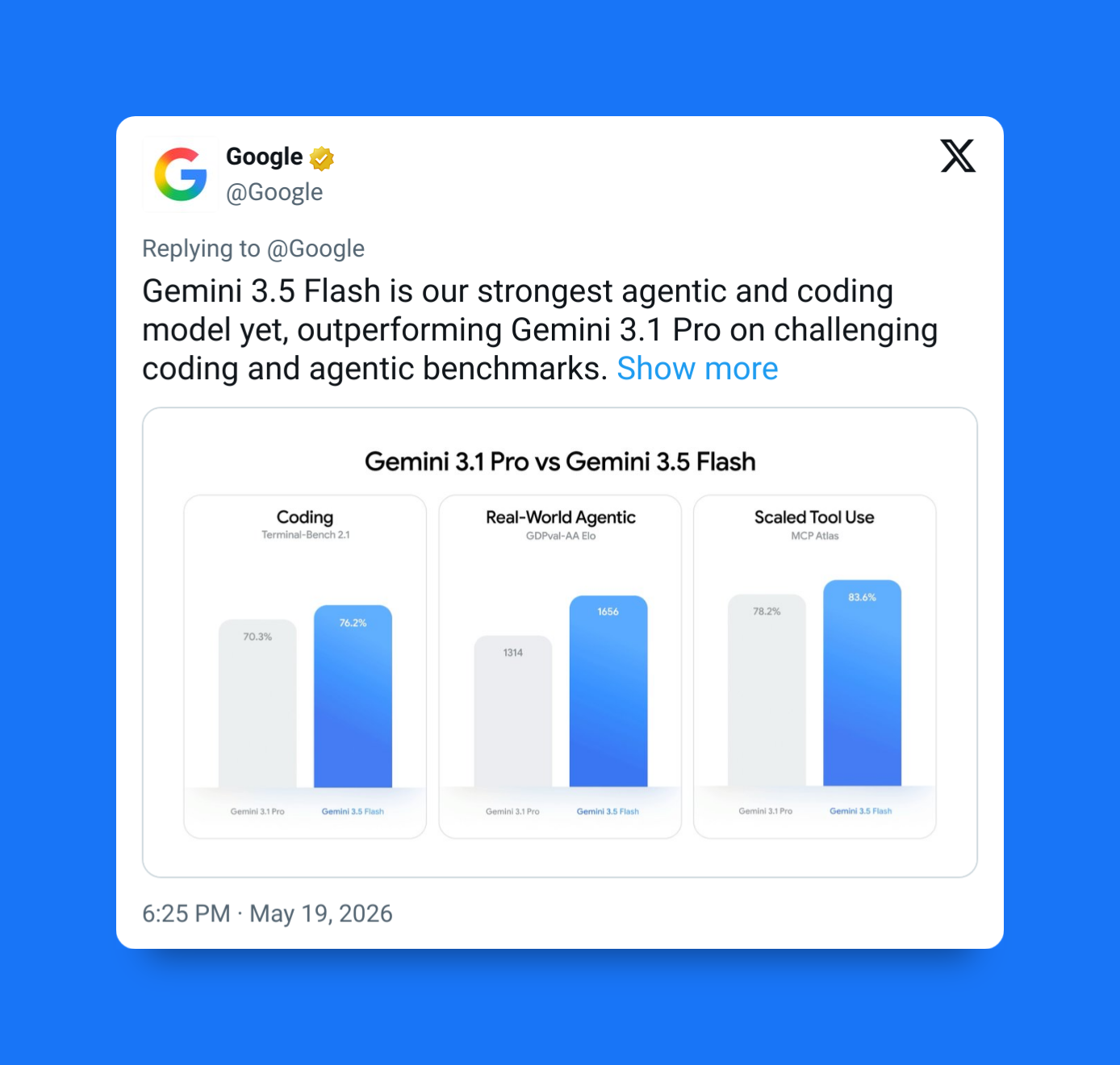
So much faster than the last version of Flash — yet somehow so much better than the last Pro version in practically every way.
And it goes way way beyond just speed or coding accuracy improvements.
We have now fast moving past the era of one agent doing all the work on its own.
Gemini 3.5 was built from the ground up for multi-agent coding and massive parallelism.
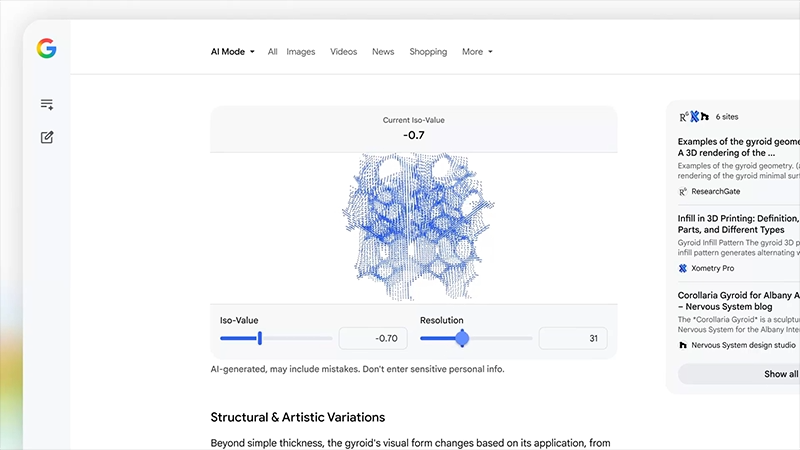
It even now generates sophisticated interactive UIs and high-resolution graphics and demos from your prompts.
1. Massive upgrades in agentic coding, terminal workflows, and software engineering capabilities
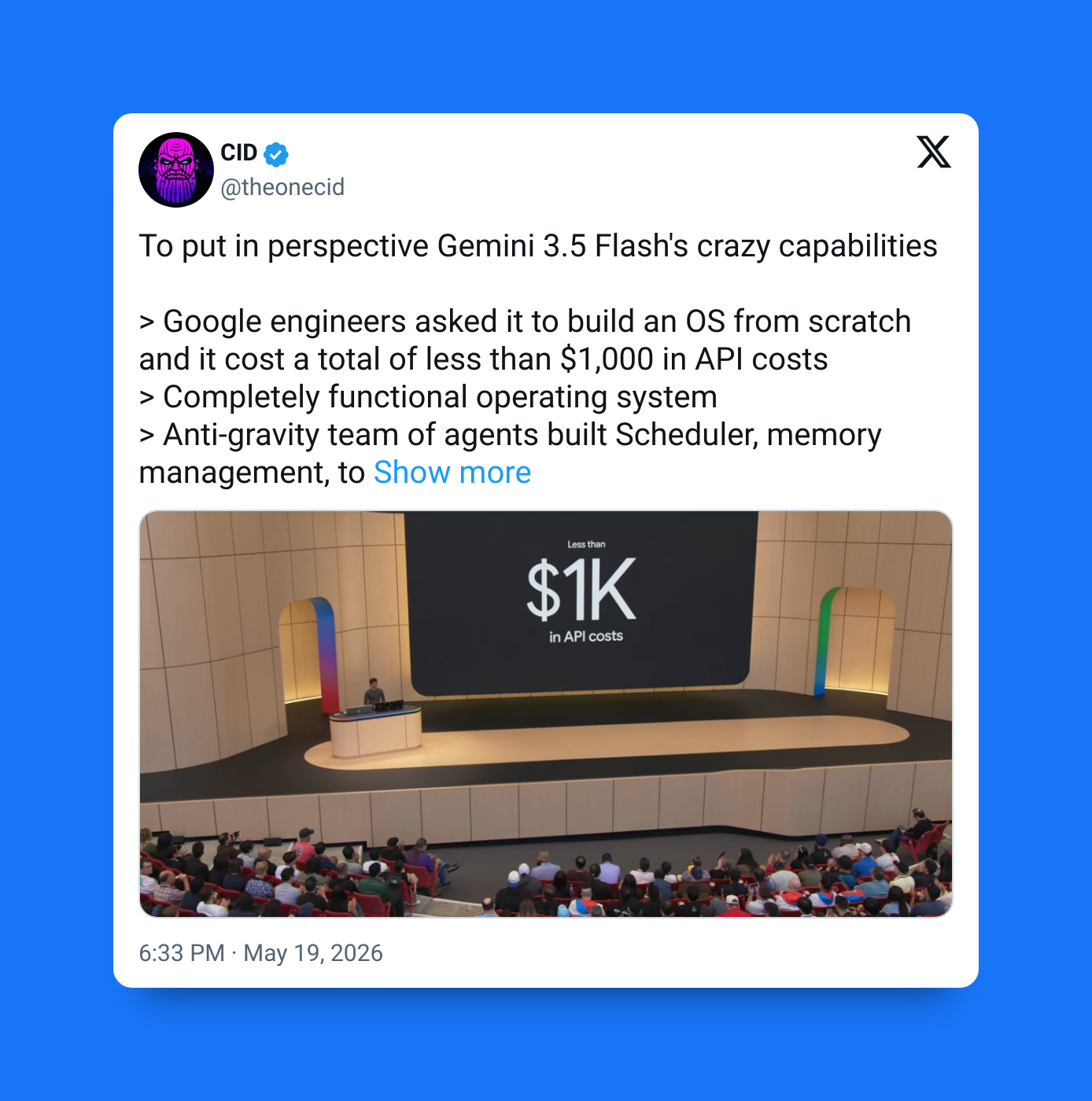
The biggest improvement in Gemini 3.5 is software engineering capability.
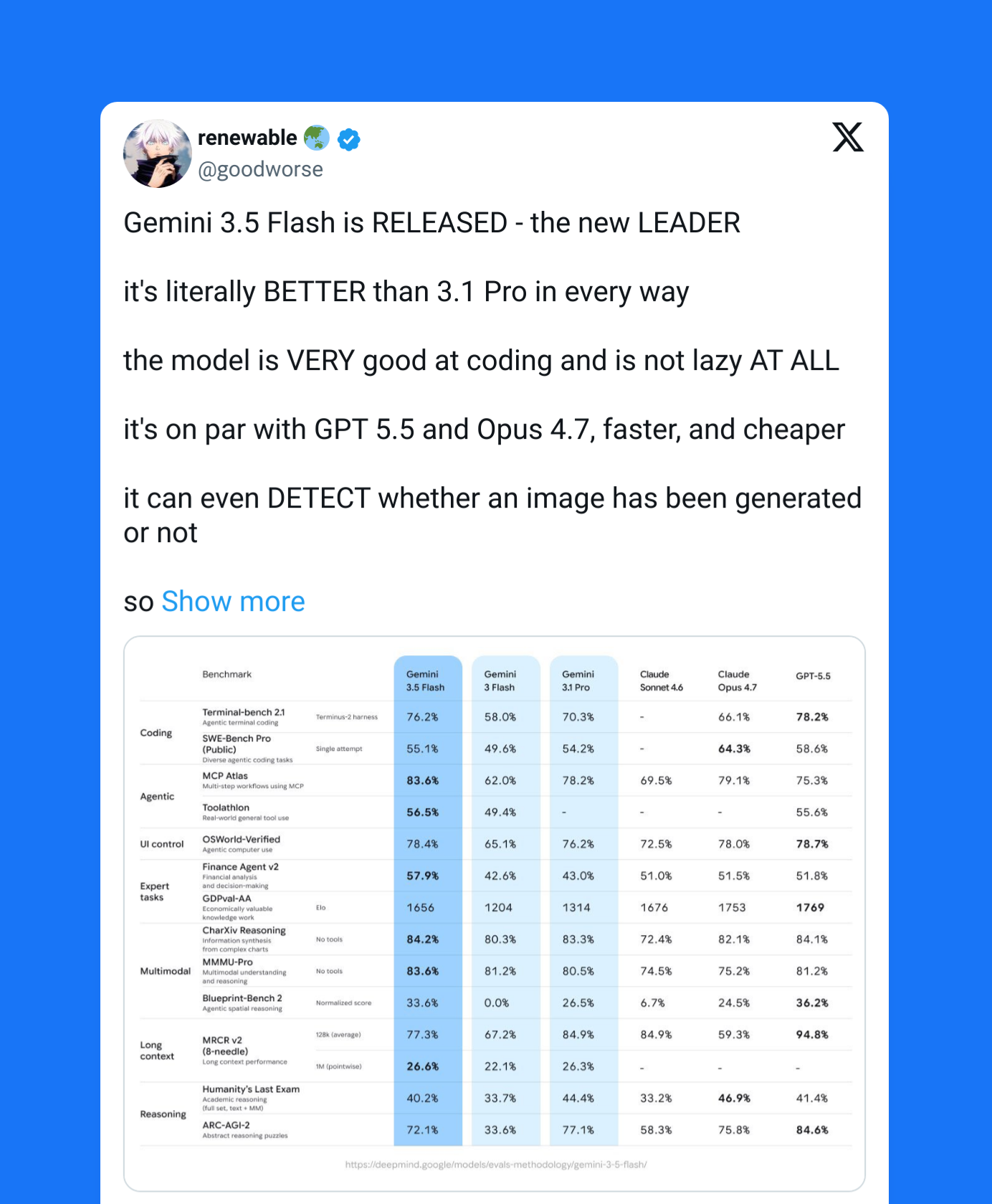
Gemini 3.5 comes with major upgrades in coding, long-horizon execution, and agent benchmarks — despite Flash traditionally being the speed tier.
The gap is so large now that Gemini 3.5 Flash is effectively replacing what developers previously expected from Pro-class reasoning models.
What stands out is its strength in agentic software workflows:
- Multi-file repository changes
- Long-running engineering tasks
- Terminal-based execution flows
- Sustained planning and execution loops
- Autonomous code modification workflows
Terminal capability especially matters because modern engineering increasingly happens outside the editor:
Git workflows, infrastructure changes, deployments, Docker environments, CI pipelines, Kubernetes operations — these are where many models still degrade.
Gemini 3.5 is much stronger in those environments, particularly on terminal-oriented benchmarks and software execution tasks.
2. Unbelievable gains in speed — blazing fast
Performance matters.
Latency changes behavior.
Google claims Gemini 3.5 Flash reaches roughly 289 tokens/sec, putting it at around 4× the speed of comparable frontier models while maintaining much stronger coding performance.
This matters because agent systems stack latency:
Planner → Subagent → Tool call → Verification → Retry → Execution
Small delays multiply.
When a model becomes dramatically faster, entire workflows become practical:
- Parallel debugging agents
- Continuous architecture reviews
- Autonomous refactoring pipelines
- Background code validation agents
- Multi-repository execution systems
Fast AI feels good.
Very fast AI changes what can exist.
3. Built for parallel agentic workflows from day one
This may be the most important architectural shift.
Most agent systems today were originally built for:
one model → one user → one response
Parallel agents came later.
Teams hacked orchestration layers on top.
Gemini 3.5 takes the opposite approach.
Google designed it around parallel agent execution, where multiple agents can split work, coordinate tasks, and execute simultaneously.
Just imagine this engineering workflow:
Agent A handles refactoring.
Agent B updates tests.
Agent C validates infrastructure.
Agent D generates migration docs.
All running concurrently.
This is no longer a chatbot pattern.
It is distributed software execution.
And it is probably the clearest signal yet of where AI development tooling is heading.
4. World-class external tool use
Coding ability matters.
Tool usage determines whether agents are actually useful in the real-world.
Gemini 3.5 scores massive improvements on MCP Atlas, one of the strongest evaluations for sophisticated tool orchestration and external system interaction.
It beat every single major model at MCP integration and tool usage.
That matters because modern agents increasingly operate through:
- IDE integrations
- APIs
- MCP servers
- CI pipelines
- Cloud systems
- Terminals
- External execution environments
Tool use is becoming the real operating system for AI.
And Gemini 3.5 is exceptionally strong at it.
5. Rich interactive UIs and graphics generated in real time
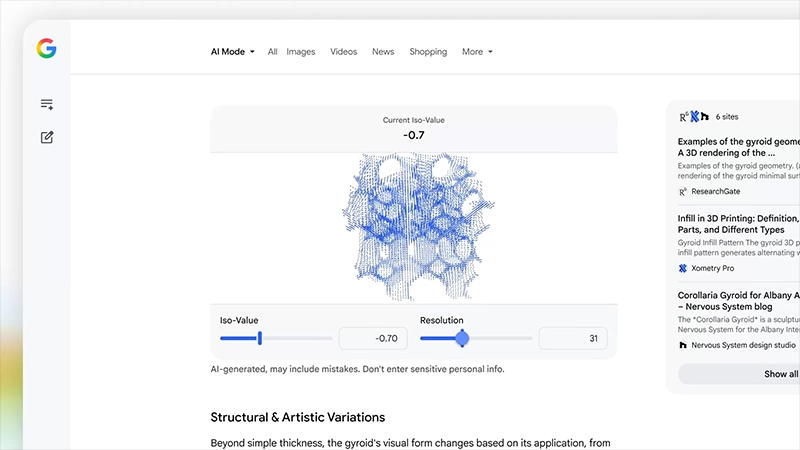
Gemini 3.5 is also pushing hard into interface generation.
Google showcased richer interactive outputs including generated interfaces, dynamic graphics, visual experiences, and interactive applications generated on demand.
Instead of generating isolated explanations and descriptions, Gemini increasingly generates:
- Interactive interfaces
- Visual systems
- Animations
- Stateful experiences
- Rich graphics