
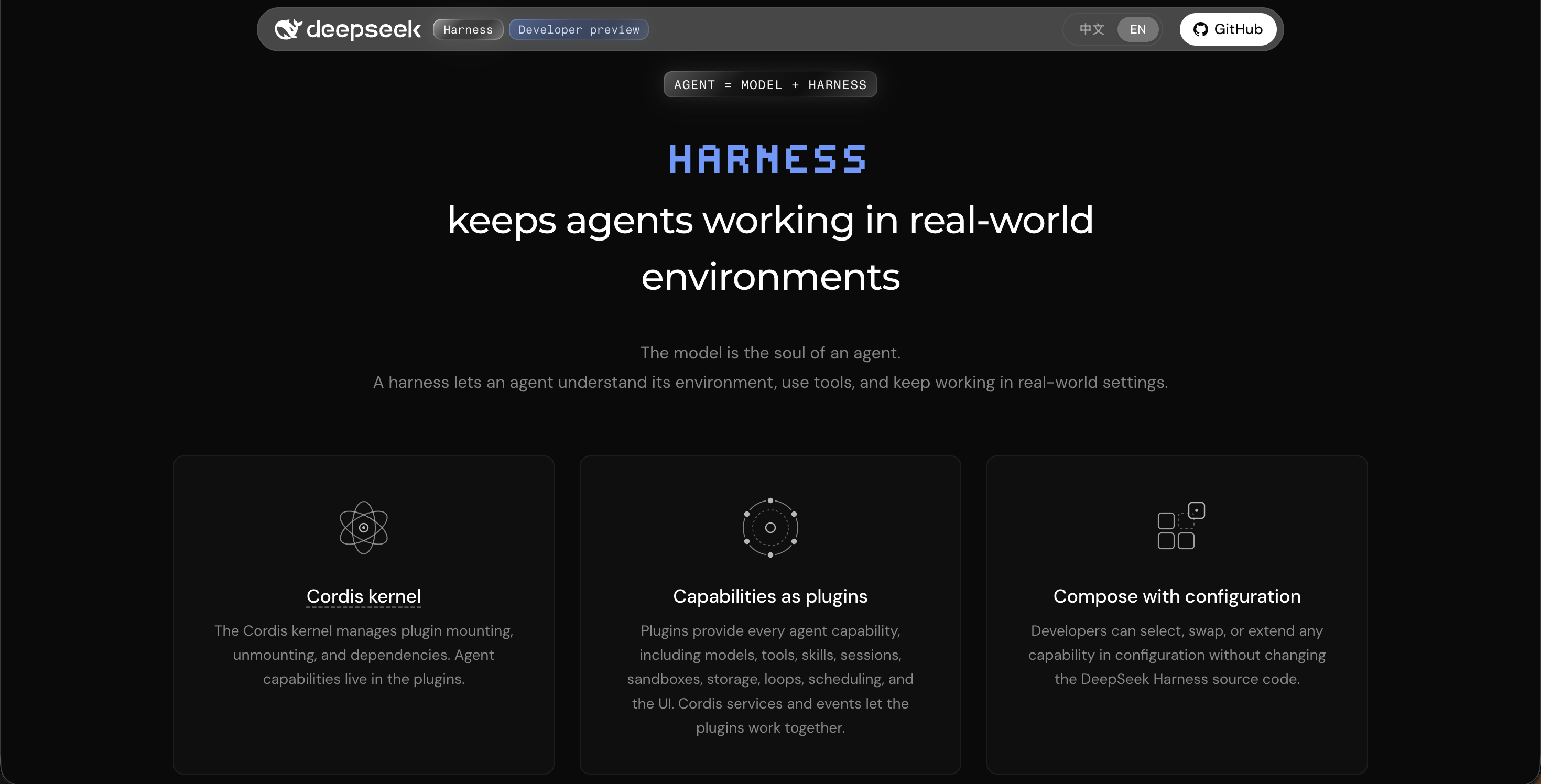
DeepSeek just released a revolutionary new open-source Claude Code competitor — but it’s so much more than that.
The new DeepSeek Harness is not just trying to be a coding agent.
It’s not even trying to compete in models or features or settings or commands.
It’s trying to compete at the AI operating system layer — the harness layer.
It’s the harness layer that really makes AI coding possible — the layer that transforms any model into an autonomous agent.
AI models on their own are very intelligent but can only chat — they need a high-quality harness to let them read files and make network requests and extend themselves with plugins and skills — like what an Operating System does for a very powerful processor.
So DeepSeek Harness is trying to be the most powerful operating system ever made — that maximizes any model to its full intelligence potential to give you the best and fastest results possible.
It’s unbelievably flexible — you can basically replace or customize every single thing.
Tools like Claude Code and Cursor let you swap models and add new extensions.
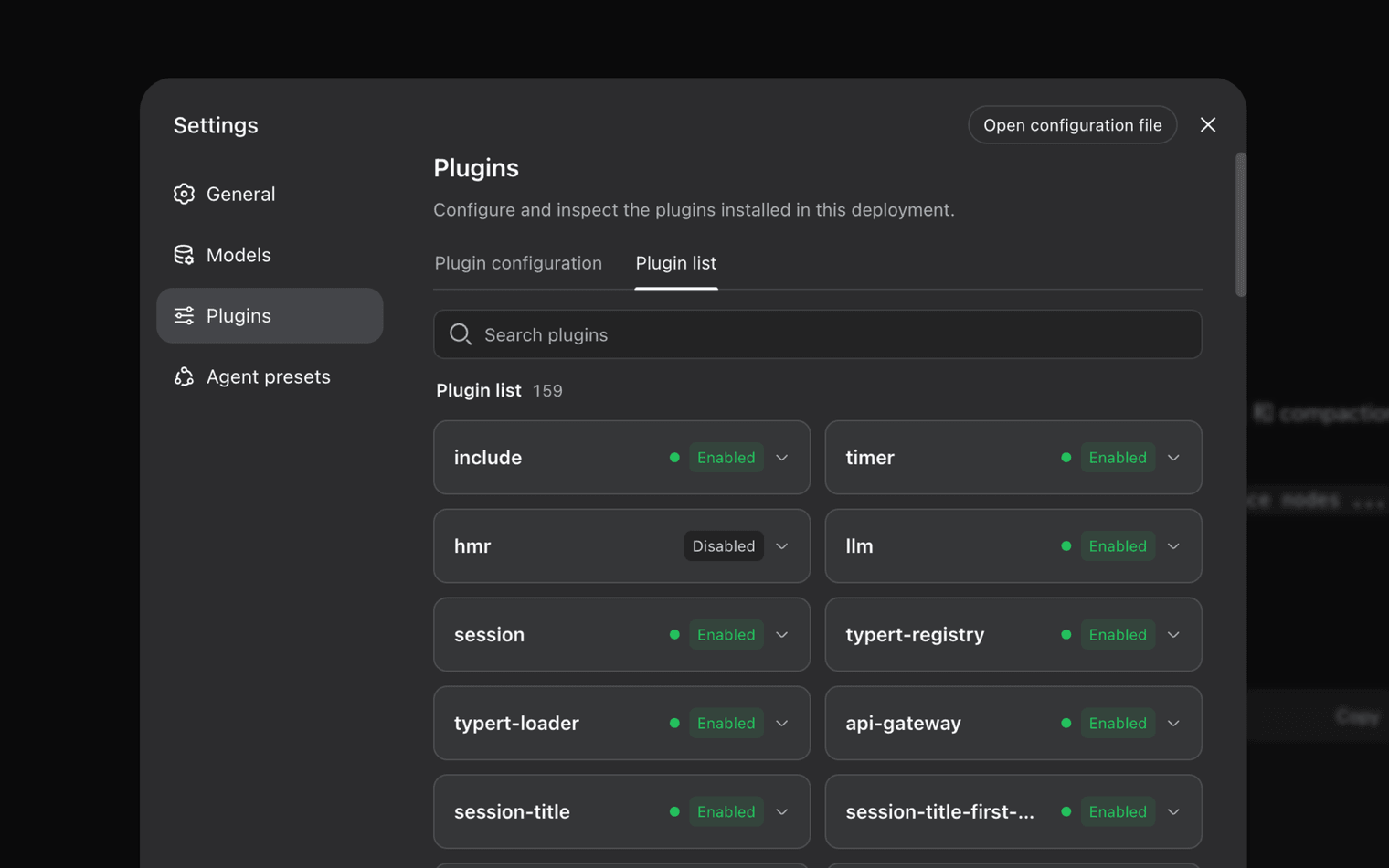
But DeepSeek Harness goes much much further — everything is a plugin — everything:
- Model adapters
- Permission systems
- Session storage
- File-system access
- Tool definitions
- Agent orchestration logic
- Even the agent execution loop itself
List of connected plugins in a DeepSeek Harness:
You are not locked into a predefined way of building agents — you can even connect it with other harnesses like Claude Code.
You can assemble your own agent stack from interchangeable components — we’ve had tech stacks, now we have agent stacks in 2026.
You can even embed an entire agent system inside a larger workflow — Agent-in-Agent Orchestration.
For example a DeepSeek Harness workflow could:
- Use Claude Code for software development
- Call OpenAI Codex for specific coding tasks
- Route research to another agent
- Coordinate everything through a parent orchestrator
And the harness itself is not limited to DeepSeek models.
It supports OpenAI-compatible API endpoints — which allows you to mix and match models across providers.
So like for example:
- DeepSeek for reasoning
- A vision model for image analysis
- Claude for writing
- Local open-source models for privacy-sensitive tasks
The framework focuses on orchestration rather than locking users into a single model ecosystem.
Four purpose-built runtime modes
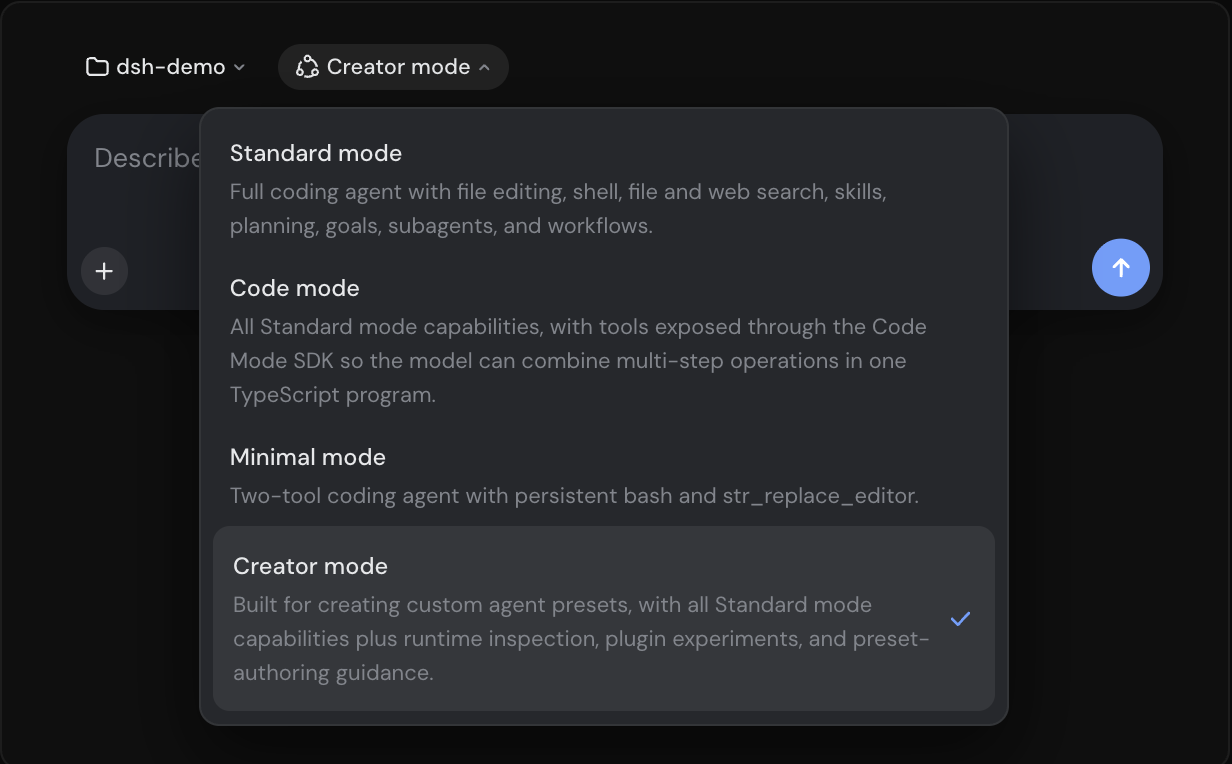
Instead of changing model intelligence, DeepSeek Harness changes the environment around the model.
Standard mode
General-purpose execution for everyday workflows.
Code mode
Optimized for long-running software engineering tasks, including:
- Planning
- Coding
- Debugging
- Testing
- Multi-step implementation
Minimal mode
A lightweight, sandboxed environment designed for benchmarking and evaluations such as:
- SWE-bench
- TerminalBench
- Research experiments
Creator mode
Perhaps the most experimental runtime.
Creator Mode allows agents to:
- Inspect plugins
- Modify plugins
- Compose new plugins
- Reconfigure parts of their own environment
Rather than simply using tools, agents can actively reshape the harness itself.
State-of-the-art generative UI
DeepSeek Harness also includes dsh-genui, a system for generating interactive user interfaces.
Instead of responding only with text or Markdown, agents can render:
- Graphs
- Dashboards
- Visualizations
- Interactive widgets
- Sandboxed mini-applications
This allows agents to present information through purpose-built interfaces rather than lengthy text outputs.
Unprecedented transparency
A major focus of DeepSeek Harness is visibility.
The framework ships with a local web interface that exposes operational details often hidden in other agent systems.
Live operational metrics
Developers can monitor:
- Token usage
- Tokens per second
- Tool calls
- Step counts
- Total turns
- Prompt cache hit rates
All metrics are available in real time.
Interactive trajectory timelines
The UI also provides a detailed audit trail showing:
- Every reasoning step
- Tool inputs and outputs
- Sub-agent activity
- Execution latency
- Context assembly details
This makes debugging, optimization, and governance significantly easier.
Built for long-running, low-cost agents
Long-running agent workflows are typically expensive because context grows over time.
DeepSeek Harness tackles this through:
- Optimization around DeepSeek V4-Flash
- Aggressive prompt caching
In extended sessions, cache hit rates reportedly reach as high as 95–100%. As a result, large portions of prompts and conversation history can be reused instead of being repeatedly processed.
What this means is huge as a developer:
- Multi-hour coding agents become affordable
- Multi-agent systems can run continuously
- Complex workflows incur far lower costs
- Long context histories become less expensive to maintain
DeepSeek Harness is not trying to be just another AI agent framework.
It is attempting to become a flexible orchestration layer for the entire agent ecosystem, with key innovations like:
- A true “everything is a plugin” architecture
- Agent-in-agent orchestration
- Model-agnostic composability
- Four specialized runtime modes
- Native generative UI support
- Deep operational transparency
- Extremely cost-efficient long-running execution
As AI systems become more complex and multi-agent workflows become more common, orchestration is starting to matter as much as model intelligence itself.
DeepSeek Harness is one of the strongest signals so far that the future of AI infrastructure will be built around composable systems, not just increasingly powerful models.