
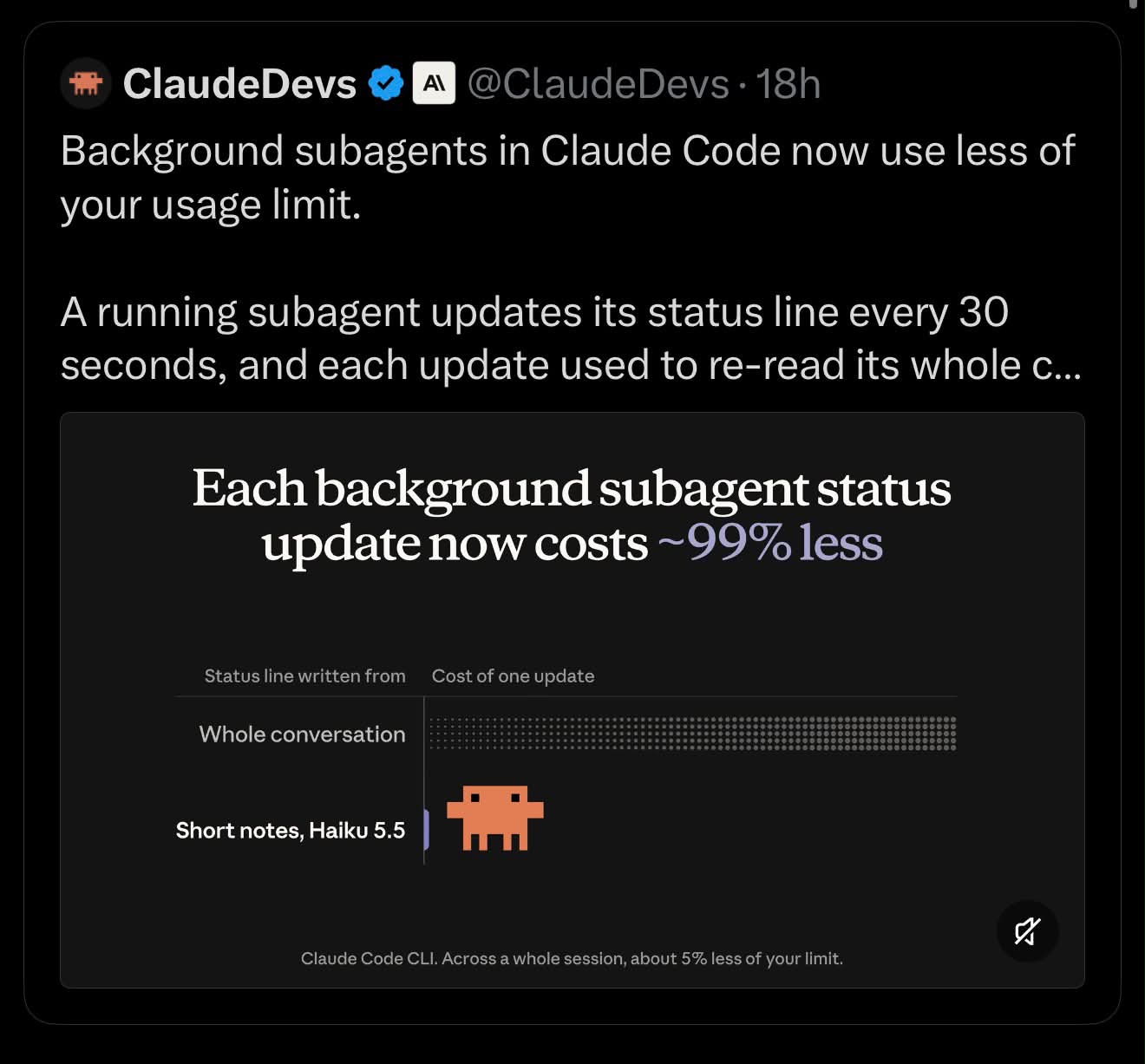
If you’re paying for Claude Pro, Max, or Ultra — you need to run claude update right now.
Anthropic just fixed a major bug that was wasting thousands of tokens during multi-agent parallel coding.
Every background subagent was silently burning your tokens every 30 seconds by re-reading the entire conversation history just to report its progress status.
The fix cuts down massively on the token costs spent on the status polling — and gives you more usage out of your limits to spend on actual coding.
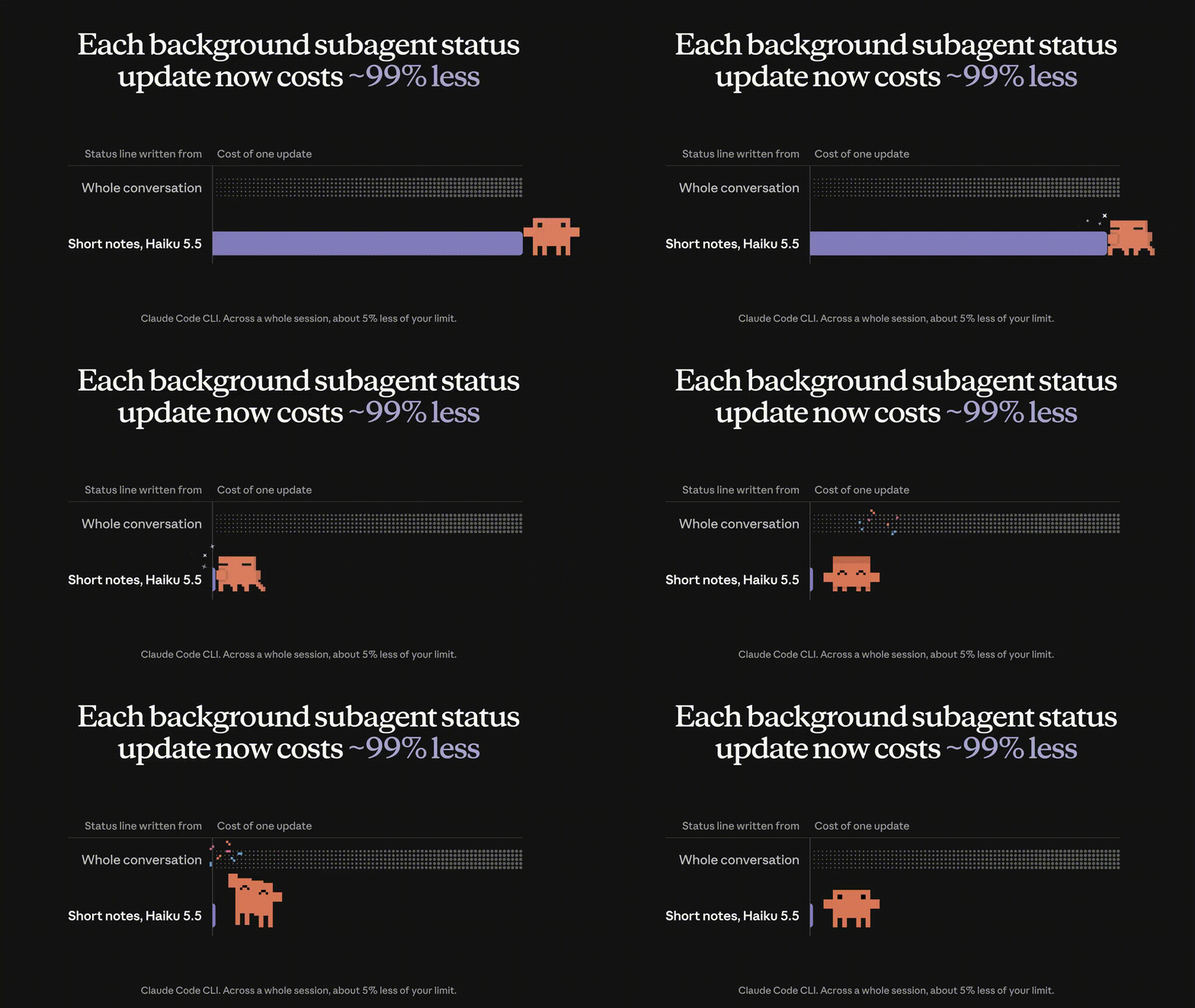
Now Claude Code now uses a much more lightweight approach.
1. Claude Code was wasting tokens on a single line of text
When you ran a background agent in Claude Code’s command-line interface (CLI), it showed a short status message every 30 seconds.
You might see something like “Analyzing dependencies” or “Running tests.”
To generate that one line of text Claude Code would read the agent’s entire conversation history from beginning to end.
And it did this every 30 seconds.
Imagine running a coding task with 100,000 tokens of conversation history. Claude could keep processing that huge amount of text just to tell you what the agent was doing.
The longer your session ran the more tokens you wasted without getting any extra coding work done.
2. Status update costs just dropped by 99%
Anthropic fixed the problem by changing how Claude Code generates status updates.
Instead of reading the full conversation history it now uses short notes and a smaller model called Haiku.
This change cuts the cost of each background status update by 99%.
That’s a massive improvement for those of us who run long coding sessions or keep several background agents working at once.
Your agents no longer need to process thousands of tokens just to report their progress.
This means less wasted usage and more tokens available for actual coding tasks. And you don’t need to change how you work to benefit from the fix.
3. The problem only affected Claude Code CLI users
Not everyone using Claude Code had this problem.
The repeated status updates were part of the CLI experience.
If you used Claude Code through the desktop app you weren’t affected by this specific issue. The desktop app doesn’t use the same terminal status-line polling system.
Those of us who spent hours running background agents in the terminal were more likely to waste tokens.
Running several agents at once could make the problem even worse.
4. Prompt caching made the problem worse
Claude Code uses prompt caching to avoid processing the same information from scratch every time.
But before the fix caching didn’t always prevent unnecessary token usage.
Every background status update could trigger another large context read.
If the cached context had expired or Claude couldn’t reuse it then the system had to process that information again at a higher cost.
Imagine paying to process thousands of tokens just to display “Checking files.”
By switching to short notes Anthropic removed much of this unnecessary overhead.
5. Developers are asking Anthropic for refunds
The fix also raised questions about the tokens people had already lost.
Some Claude Code users were frustrated to learn that background status updates had been consuming their usage limits.
For Pro and Max subscribers this meant hitting quotas sooner than necessary. For API users it raised concerns about money spent on unnecessary requests.
Some developers have called for Anthropic to restore affected quotas or offer credits for wasted usage.
Nobody wants to spend their limited AI usage on a status message that could have cost almost nothing.
There’s still no confirmed broad refund program tied to this issue.
Anthropic’s fix means we can spend more of our Claude Code usage on actual coding instead of unnecessary background updates. But it also raises a fair question about how much of our previous usage went toward work we never needed.