
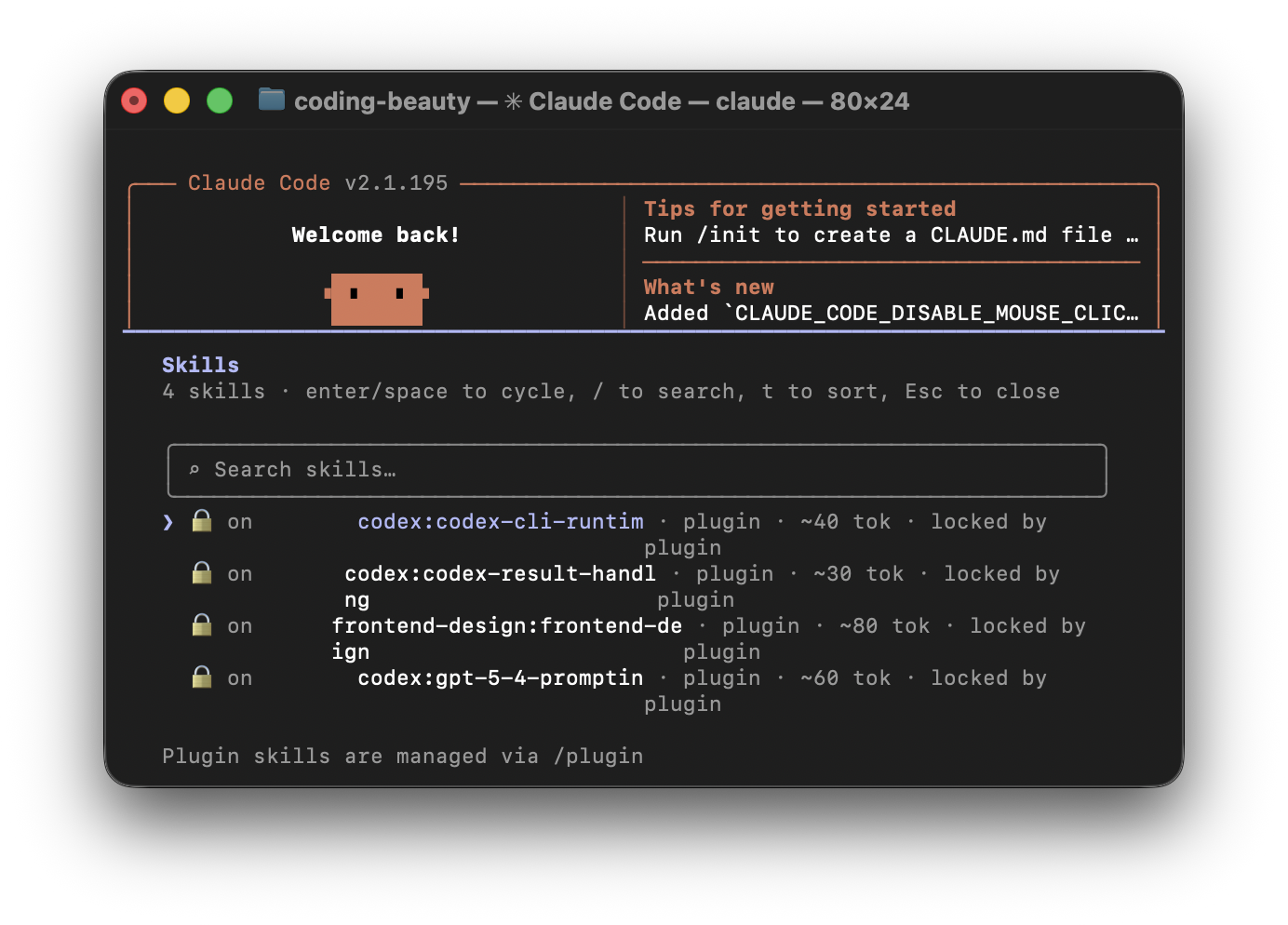
Claude Skills have had such a huge impact on the entire AI coding ecosystem.
Yet many developers still choose to ignore them and just keep prompting — unaware of the massive transformative effects this could have on their workflow.
Skills have been as game-changing as the Model Context Protocol (MCP) — and these two form a deadly combo when put together.
MCP lets your agents do real things, Skills teach them how to do those thing — in a much more sophisticated way than normal prompting.
Instead of stuffing thousands of lines of instructions or coding standards into every conversation, Skills package instructions, workflows, scripts, and supporting resources into reusable modules that Claude loads only when they’re relevant.
That makes them more context-efficient, more reliable, and far more capable than traditional prompt engineering.
Here are 5 incredible things that make Skills so essential in every serious developer’s daily workflow.
1. Intelligent progressive disclosure
Claude Skills uses a clever three-level loading system to choose the exact skill to deploy at the right moment.
- Level 1: Claude always loads a tiny YAML metadata header describing each skill.
-
Level 2: If your request matches that metadata, Claude loads the skill’s
SKILL.mdinstructions. - Level 3: Large reference docs, examples, and edge-case documentation stay in separate files that Claude only opens if a workflow explicitly requires them.
Context window bloat has always been one of the biggest limitations of LLMs.
If you preload every workflow into every conversation, you quickly waste tokens and dilute the model’s attention.
Instead of carrying every playbook into every prompt, Claude expands only the knowledge needed for the current task.
2. Skills can run in multiple invocation modes
Claude Skills gives you two different invocation modes.
Passive Context runs automatically in the background. For example, a TypeScript Conventions skill can ensure Claude never uses any, always prefers interfaces, and follows your team’s coding standards whenever it writes code.
Direct Actions are explicitly invoked workflows. Commands like /commit or /review-pr trigger structured, repeatable processes without requiring you to rewrite the same instructions every time.
This gives you both invisible guardrails and reusable automation.
3. They’re more than prompts — they execute code
Traditional prompts rely entirely on probabilistic reasoning.
Claude Skills can also include executable Python, Bash, or other local scripts, allowing them to combine AI reasoning with deterministic execution.
For example, a skill can generate code, run a compiler or linter, validate a database schema, execute tests, and feed those verified results back into Claude before continuing.
Instead of guessing whether something works, the workflow can prove it.
4. Skills can learn from your codebase
Advanced skills often maintain a persistent learnings.md file.
As Claude encounters unusual bugs, failed approaches, or project-specific edge cases, it records what it learned. Future executions can read those notes before solving similar problems.
Rather than remaining static instructions, Skills gradually adapt to the realities of your codebase over time.
5. Skills can work together
Skills aren’t limited to acting in isolation.
A complex request might trigger a Research Skill, which hands its findings to an Architecture Skill, followed by a Testing Skill that generates unit and integration tests.
Some advanced workflows can even spawn sandboxed subagents to perform independent tasks — like gathering database metrics via MCP — before reporting the results back to the primary workflow.
Instead of one giant prompt trying to do everything, specialized skills collaborate to solve increasingly complex engineering tasks.
Claude Code Skills symbolized a major transition from prompt engineering to capability engineering.
Progressive loading keeps context efficient, passive and direct invocation make workflows flexible, executable scripts provide deterministic reliability, persistent learnings help skills evolve with your project, and composable skills enable sophisticated agentic workflows.
The result isn’t just a smarter prompt — it’s an intelligent, reusable system that continuously expands what Claude can do.