Most developers don’t realize just how many tokens Claude Code wastes by default in just trying to understand your codebase.
Every noisy search result, duplicate reference, and irrelevant file eats into your context before the real work even begins.
Increasing your API costs and slowing down responses significantly.
But luckily, we now have the incredible Language Server Protocol (LSP) integration to fix all this.
It’s one of the least talked about features that dramatically transforms how Claude processes your code and makes changes.
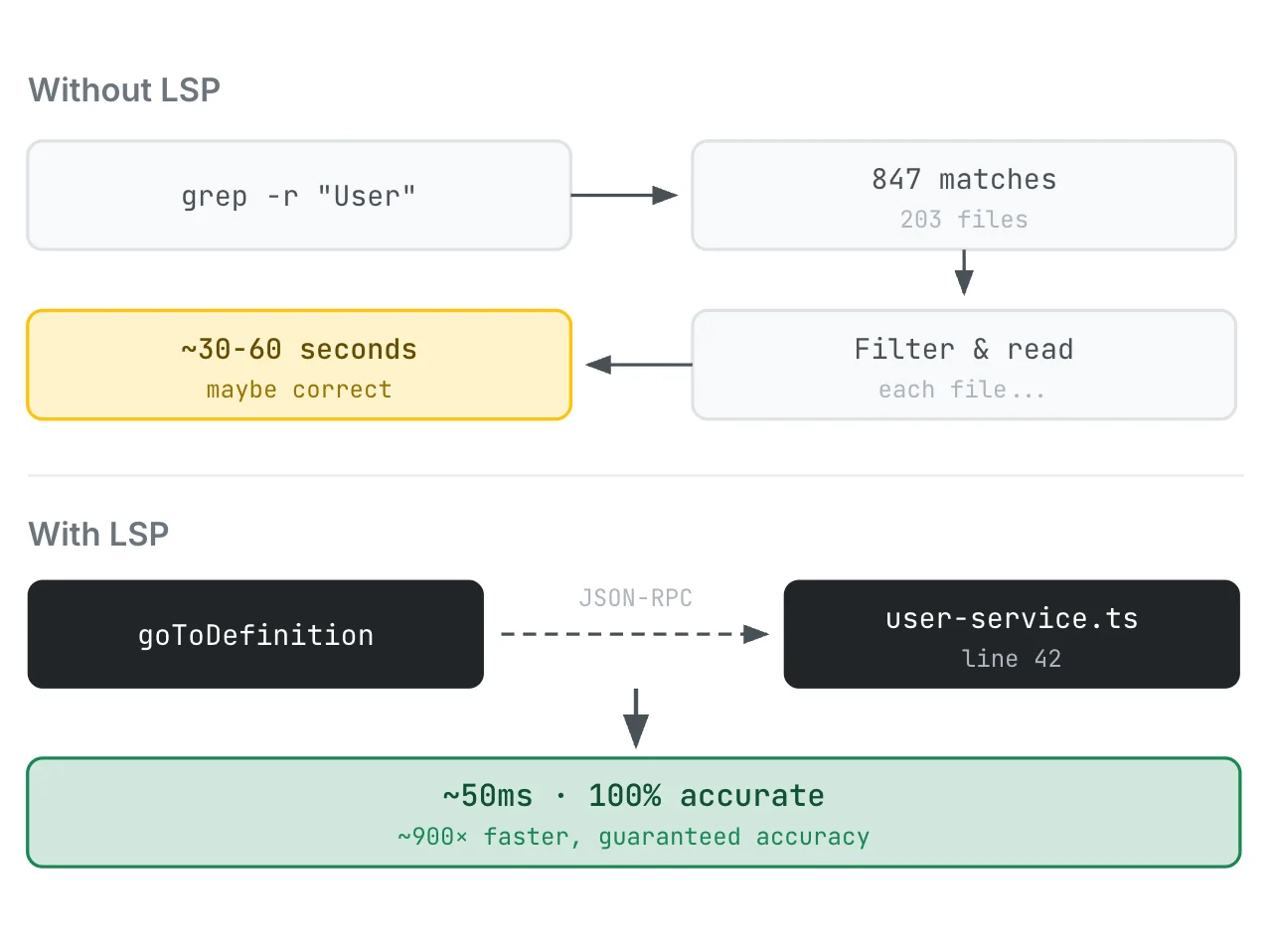
By swapping heavy text searches for instant AST queries, LSP cuts lookup times from 30–60 seconds down to a 50-millisecond response, delivering up to 900x faster code navigation speeds
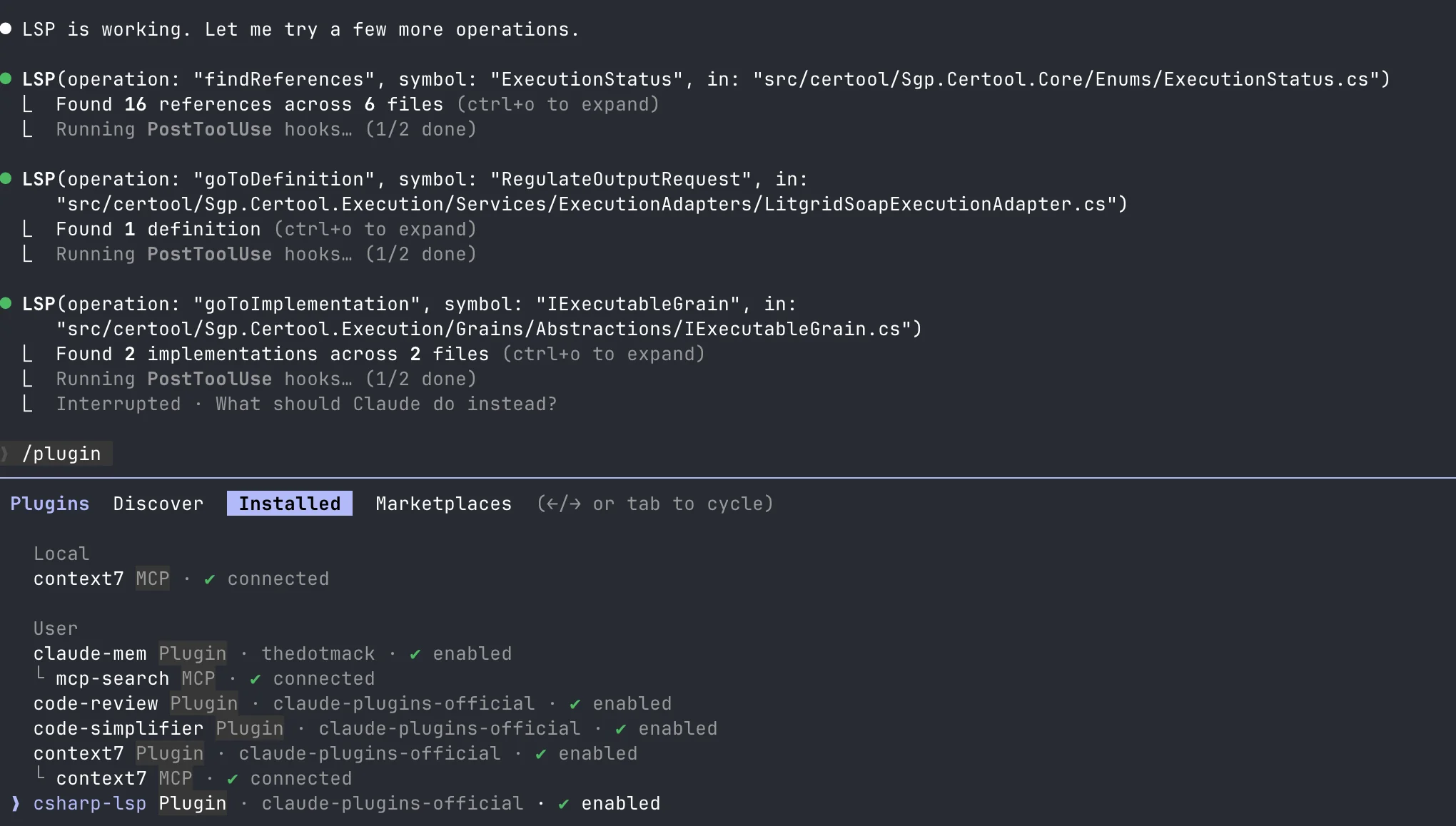
With LSP Claude Code stops relying on text searches — it directly queries a language server that already understands your project’s structure. What you get is an AI assistant that behaves much more like a modern IDE than a just a chatbot. You get the best of both worlds.
LSP powers many IDE features we’ve been using to code everyday years before AI came around, like:
Go to Definition
Find References
Rename Symbol
Type checking
Error diagnostics
Hover documentation
Rather than treating code as plain text, LSP exposes semantic information such as symbols, types, inheritance, and references.
Imagine asking:
“Where is UserRepository used?”
Without LSP, Claude performs a text search that may return:
the definition
dozens of call sites
comments
documentation
test files
unrelated string matches
Claude must read all of that before determining what actually matters.
With LSP, Claude asks the language server for the symbol’s references and receives only the precise locations where that symbol is used. Instead of searching text, it navigates your code semantically.
The difference becomes even more valuable in large repositories.
Enterprise projects often contain:
thousands of files
millions of lines of code
hundreds of packages
Traditional searches repeatedly scan those files. Language servers already maintain indexes of definitions, references, implementations, and type information. Claude simply queries those indexes, making navigation faster and far more precise.
One of the most underrated advantages of LSP integration is token savings.
Every line of search output consumes tokens, increases latency, and costs money. Text searches often return much more information than Claude actually needs, including comments, documentation, duplicate references, and unrelated matches. Claude has to spend part of its context window filtering that noise.
LSP eliminates most of this overhead. Instead of returning pages of search results, it provides only the relevant semantic information, such as:
the symbol definition
exact references
implementation hierarchy
type information
In large codebases with heavily referenced symbols, LSP-driven navigation can produce tool outputs that are 2–3× smaller than equivalent text searches.
That means:
lower API costs
faster responses
less wasted context
more room for Claude to reason about your code
LSP also makes refactoring much safer.
Suppose you rename a class called PaymentProcessor.
A simple text replacement could accidentally modify comments, documentation, string literals, or unrelated variables. A language server understands symbols rather than text, allowing Claude to rename only the actual class and its legitimate references.
Another major advantage is immediate diagnostics.
After Claude edits a file, the language server can instantly report:
syntax errors
missing imports
unresolved identifiers
type mismatches
Instead of waiting for a build or CI pipeline to fail, Claude can identify and fix problems immediately.
Sometimes people confuse LSP with the Model Context Protocol (MCP), but they complement each other rather than compete.
LSP helps Claude understand your source code.
MCP helps Claude interact with external tools such as GitHub, Slack, databases, and cloud services.
Together they allow Claude to understand both your application and the ecosystem around it.
LSP shifts Claude from simply reading code to actually understanding it. Rather than treating a repository as a collection of files, Claude reasons about symbols, relationships, types, and program structure.
The result is:
faster navigation
safer edits
better refactoring
immediate feedback
lower token usage
LSP integration may not be as flashy as autonomous agents, but as a developer working on real-world codebases, it’s one of the most meaningful ways to level up your Claude Code workflow.