
Recently Claude Code got native AGENTS.md support — and it has made AGENTS.md more important than ever.
AGENTS.md is a universal standard for controlling Claude Code and other agents. It tells AI coding agents how to work inside a codebase.
It can define project structure and coding rules. It can also tell agents which commands to run and where to find deeper documentation — giving them useful context before they start working.
With AGENTS.md you can become a lot more productive by spending less time explaining the same thing to your coding agent.
It also helps us spend much less on tokens and guarantee more reliable results across coding sessions and tools.
Let’s look at the various ways AGENTS.md helps us as developers.
1. Flexible AI coding — use multiple tools without rewriting your project instructions
This benefits became even greater these past few days when Claude Code gained native AGENTS.md support.
Coding tools often have their own way of storing project instructions.
You might have files like:
.cursor/rules/

CLAUDE.md

.github/copilot-instructions.md

AGENTS.md
This gets messy when you decide to use different tools.
You’d have to copy rules and coding conventions across several files. Those copies can drift — one gets updated while another still gives an agent old instructions.
AGENTS.md gives teams a vendor-neutral place for those rules.
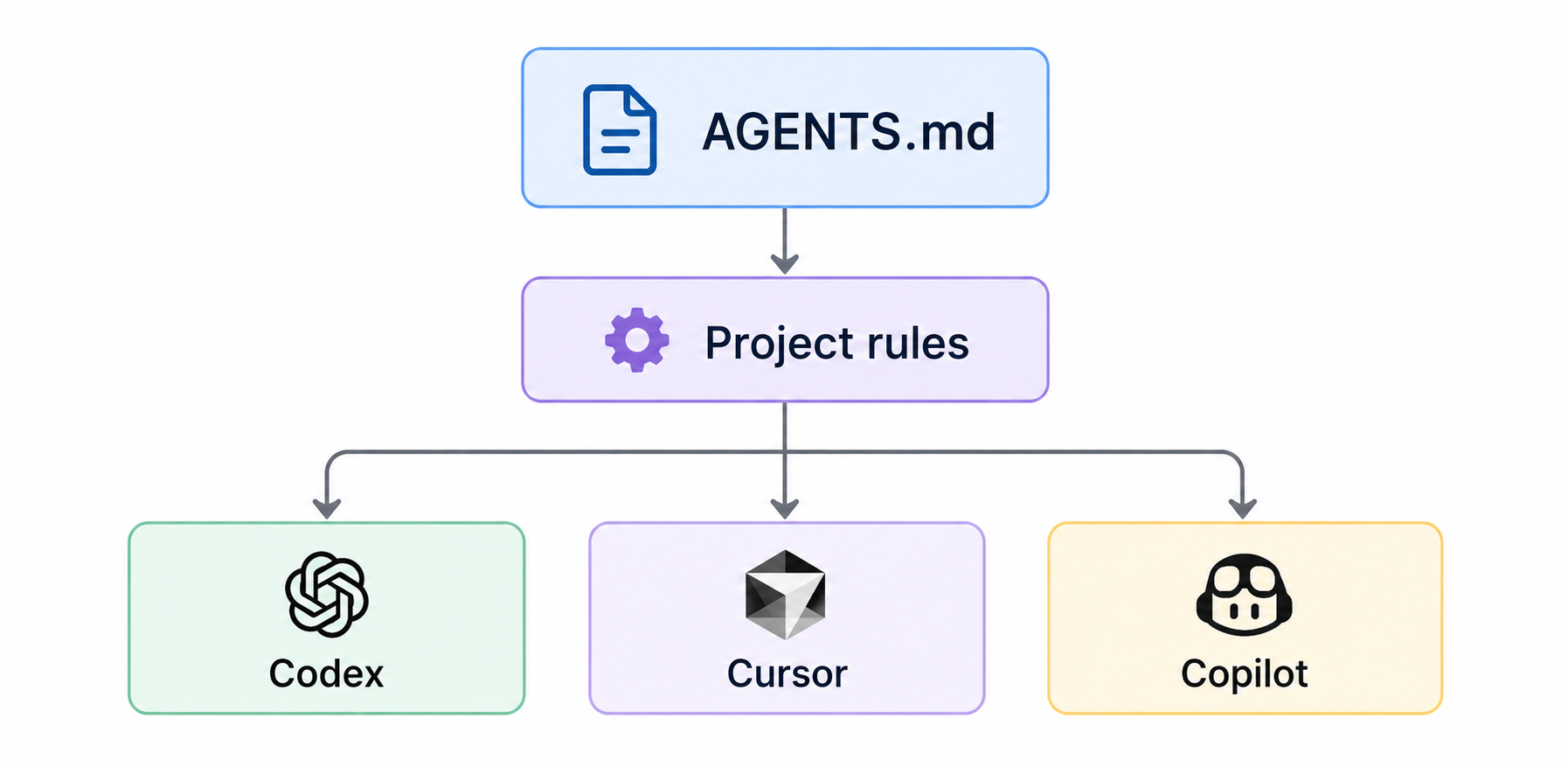
Not every tool handles AGENTS.md in the same way. Some still use their own instruction files.
But AGENTS.md can act as the single source of truth they point back to.
Developers get less vendor lock-in — they can switch agents without having to reteach the codebase.
2. Spend fewer tokens and get faster agent responses
Large repos contain much more information than an agent needs for one task.
Say an agent needs to fix authentication middleware. It probably doesn’t need to read the mobile app or billing service.
But without guidance it may search those areas while trying to work out what matters.
Every file and document it reads adds context. That can increase token use and API costs — it can also fill the agent’s context with information it doesn’t need.
A clean AGENTS.md can work as an index and map:
## Repository map

Authentication:

services/auth/

Shared API types:

packages/api-types/

## Validation

Auth tests:

pnpm test services/auth
The agent now knows where to start and which commands to use.
This means fewer wasted tokens and faster agent runs. AGENTS.md can also point to deeper docs so the agent only loads them when needed.
3. Write shorter prompts and spend less time repeating Yourself
As developers we often give agents the same instructions again and again.
Run the tests. Don’t edit generated files. Use the right package manager. Follow the existing architecture.
Those instructions aren’t the task — they’re the rules for working in the repo.
AGENTS.md lets developers write those rules once. Prompts can then focus on what they actually want built.
That means less time writing long prompts and less chance of forgetting an important rule.
The developer explains the goal — the repo explains how work should get done.
4. Get developers and AI agents productive faster
New developers and new AI agents have the same basic problem.
Neither knows the repo yet.
They need to know where things live and how to run the project. They also need to know how to test changes.
Without clear guidance both have to explore.
AGENTS.md gives them that baseline knowledge from the start — so they spend less time figuring out the repo and more time doing useful work.
It also gives developers and agents a shared understanding of the project.
The result is faster onboarding and clearer communication between humans and AI.
5. Get more consistent AI code and spend less time fixing mistakes
Without shared instructions every developer can end up with a different AI workflow.
One developer tells the agent to run tests. Another expects it to know. One explains the architecture while another lets the agent work it out.
AGENTS.md puts those expectations in one shared place.
The whole team can define its coding rules and validation steps — so agents start with the same baseline.
That means fewer predictable mistakes and less time fixing AI-generated code during review.
The team can also update AGENTS.md as the project changes.
AI instructions stop living inside personal prompts — they become part of the project.
Less AI overhead means more time building
AGENTS.md gives coding agents a better map of the projects they work on.
For us developers the benefits are practical: less vendor lock-in and fewer wasted tokens. Prompts get shorter and onboarding gets faster — AI-generated code can also become more consistent.
AGENTS.md doesn’t make the model smarter.
It gives the model a better environment to work in — so developers can spend less time explaining their codebase and more time building.