
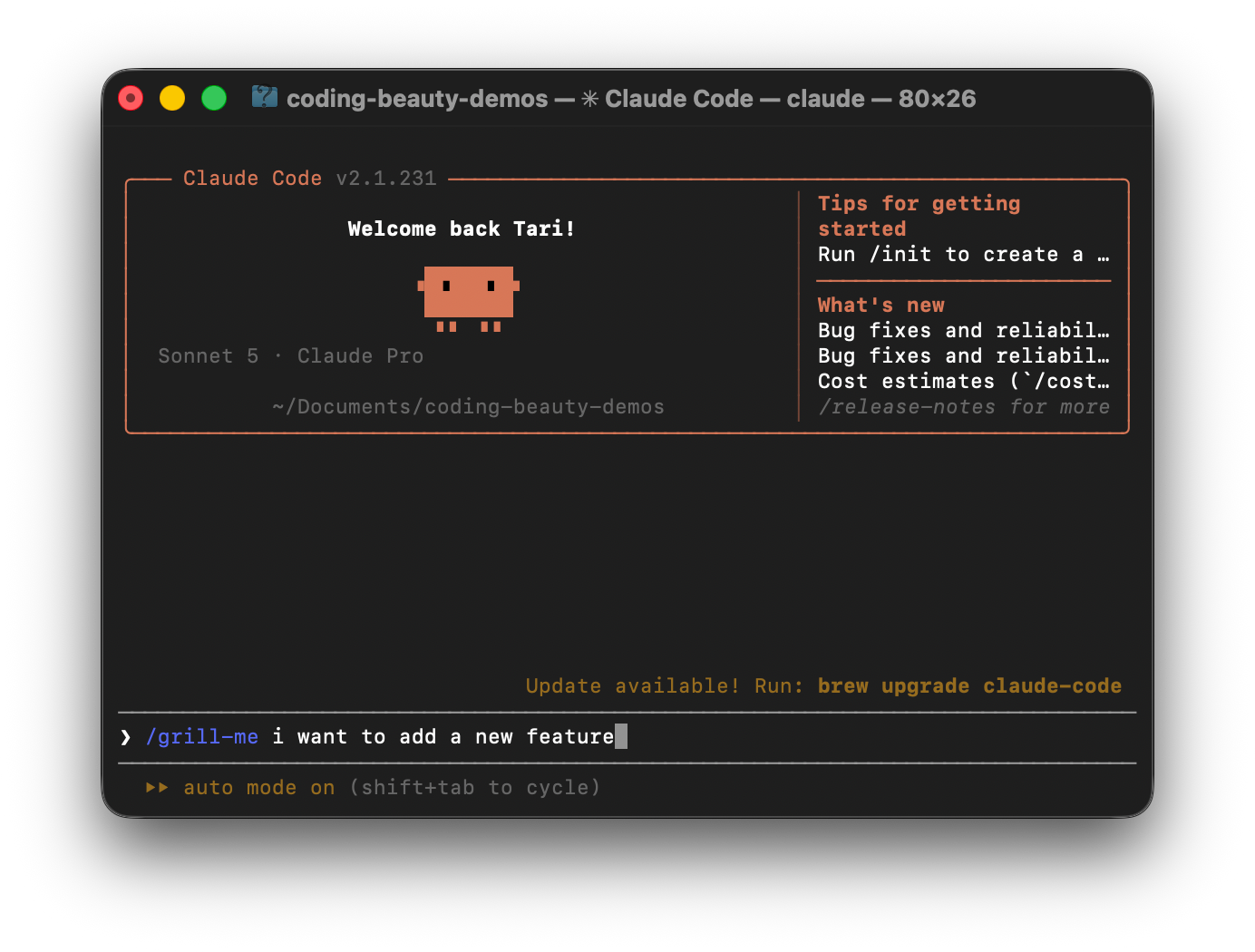
grill-me has been one of the most transformative skills in the AI coding ecosystem.
It’s a powerful skill that turns Claude Code into an interviewer to poke holes in your assumptions and find flaws in your thinking.
It reveals blind spots, catches subtle problems and helps you make better technical decisions.
It gives you a deeper understanding of your overall development process, and improves the overall quality of your code.
Let’s look at the key features that makes it such a valuable part of your workflow.
1. Inverted roles — find blind spots before you build
There is a problem with asking AI to review your work — you still need to know what to ask.
If you forgot about concurrency then you may never ask about concurrency.
/grill-me solves this by taking control of the questions.
Say you tell it that users upload files before you add a processing job to a queue. It might ask:
What stops the same upload from being processed twice?
This is an important edge case you might have never thought of.
Your answer gives it somewhere new to dig.
Which parts of the processing pipeline are actually idempotent?
You are no longer asking AI to confirm your design. You are defending it — which can expose crucial missing requirements before you spend hours building the wrong thing.
2. Socratic pressure testing — catch problems before production
A good grill does more than run through a checklist. It questions the assumptions behind your answers.
It looks for the parts of a design that seem obvious but have not been fully thought through.
This can uncover race conditions and security risks. It can also find weak retry logic or scaling limits that normal AI conversations may miss.
The benefit is clear — you find failure cases during design instead of finding them at 2 a.m. in production.
3. Dynamic pressure testing — make better technical decisions
/grill-me doesn’t follow a fixed list of questions. It changes direction based on your answers.
A strong answer can move the conversation forward. A vague answer gives the AI a reason to dig deeper — especially when your reasoning depends on an assumption you haven’t proved.
This pushes developers to turn vague ideas into clear technical decisions.
It also makes those decisions easier to explain later. You have already had to think through the tradeoffs and defend why your approach works.
4. Customizable personas — get expert review on demand
You don’t always need the same kind of review.
A friendly grill can act like a senior engineer helping you spot things you missed. A tougher one can challenge every weak assumption you make.
You can also change who is doing the grilling.
Ask for a security engineer and the questions can focus on authentication or trust boundaries. Ask for an SRE and the focus can move to outages and recovery. A database expert can dig into indexes and transactions.
It gives developers another set of eyes without waiting for the right expert to become free.
5. Context-aware scrutiny — get feedback on your actual code
Generic architecture questions only go so far.
/grill-me becomes much more useful when it can read the project itself. It can use your code and specs to understand how the system really works.
That makes its questions specific to your project rather than based on textbook problems.
It also saves developers from explaining everything from scratch. The AI can find facts in the project — while the developer focuses on explaining and defending the decisions behind them.
A sparring partner — ship with fewer surprises
AI has made writing code much faster.
It has not made bad assumptions cheaper.
In fact AI agents can turn one bad assumption into thousands of lines of convincing code very quickly.
/grill-me adds friction before that happens — the useful kind.
Attack the idea before implementing it. Find the failure cases before users do. Question the assumptions before they turn into technical debt.