
For the past few years until now it’s been all about Large Language Models (LLMs).
From generating code to drafting essays, LLMs showed us their remarkable ability to work with language and solve complex problems.
But inside modern AI-powered software systems, an interesting problem emerged.
Today, as developers we increasingly use large conversational models for tasks that don’t need any conversation at all:
- deciding which action an automated agent should take next (like which button to click on a page)
- tagging and sorting text data
- deciding the next step of an AI-powered workflow
- routing customer-support tickets
- checking whether content violates a policy
In these situations, the application doesn’t need generated text. It needs a decision. It needs cold hard data — and fast.
That is the problem that Jev, a new trending model from TypeSafe AI, is here to address.
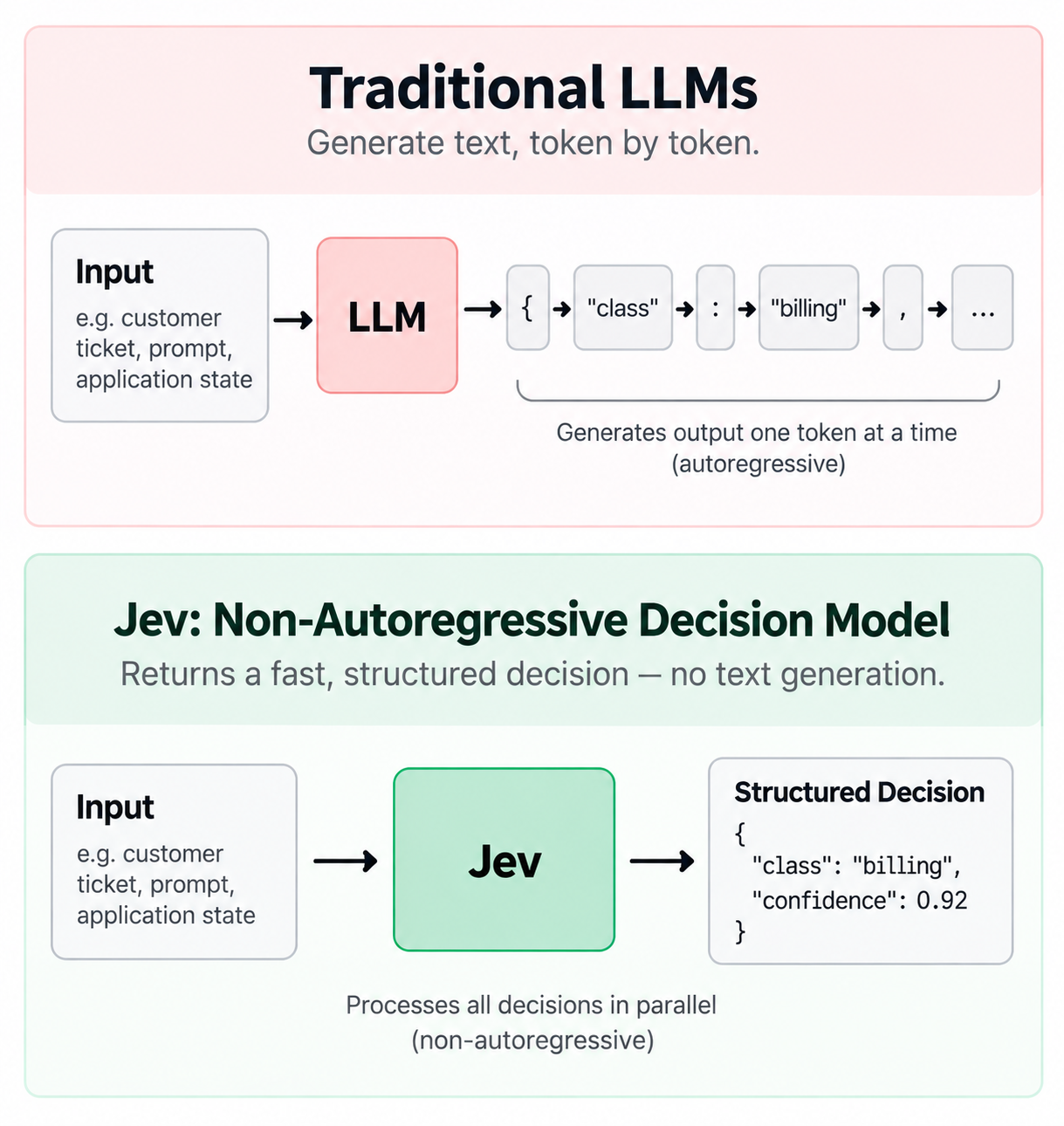
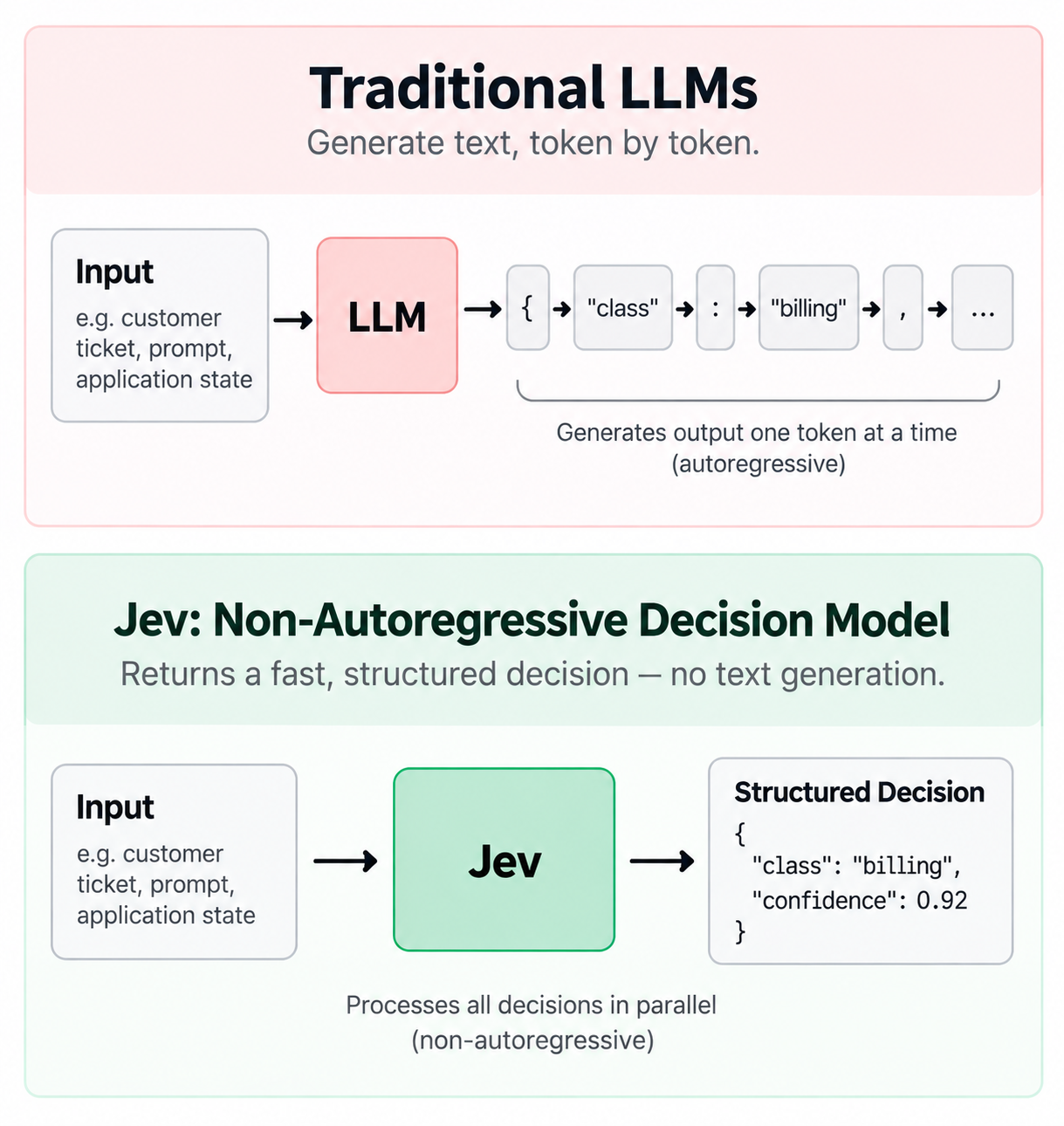
Jev represents an emerging category of non-autoregressive decision models.
Instead of generating natural-language responses, these models take application state and return constrained, probabilistic decisions.
They skip the LLM conversation layer entirely to focus on pure processing logic and decision making, which makes it much faster, among other benefits.
1. Much lower latency in AI model processing
Traditional LLMs generate responses autoregressively, producing one token after another. That makes sense for paragraphs or code, but it is inefficient when the goal is simply to “approve or reject” or “choose one of these categories.”
Jev-like models instead produce bounded decisions directly.
According to performance claims associated with Jev, this faster processing can take roughly 70–300 milliseconds — as much as 40x to 200x faster than using conversational LLMs to do it.
This makes AI decisions much more practical for UI automation, interactive applications, automated agents, and other latency-sensitive workflows.
2. Fewer parsing problems
LLM developers know the familiar instruction: “Respond ONLY with valid JSON.”
Yet models can still occasionally return Markdown, extra explanations, unexpected fields, or invalid values. Developers compensate with validation, constrained outputs, and retry logic.
Jev takes a different approach by eliminating arbitrary text generation. Its interface is based on constrained primitives like:
- Choice: Select an option from a predefined set.
- Noul: Evaluate a boolean condition with a probability.
- Score: Evaluate input against an ordered scale.
Because it knows all its outputs in advance, applications can avoid many of the parsing and formatting problems associated with free-form generation.
3. Lower model processing costs
Cost becomes especially important when AI operates as invisible infrastructure.
A chatbot might receive a handful of requests per user — but a backend model could be invoked hundreds of times during automated workflows.
TypeSafe AI lists Jev’s input processing at approximately $0.042 per million tokens — and without an output-token charge — because it does not generate text.
We’re getting reports of cost reductions of roughly 40× to 400× for some structured classification workloads compared with generative LLMs.
The underlying idea is simple: if an application needs a classification rather than a sentence, paying to generate that sentence may be unnecessary.
4. Usable confidence scores
Conversational models often express incorrect answers with the same confident tone as correct ones. For automated systems, that makes uncertainty difficult to interpret.
Decision models can instead expose probabilities directly and optimize for calibration. Jev uses an approach called Reinforcement Learning for Calibrated Decisions (RLCD).
In principle, well-calibrated probabilities allow us as developers to create practical automation thresholds. High-confidence decisions might execute automatically, medium-confidence cases could go to human review, and low-confidence cases could be escalated.
That turns uncertainty into something application code can actually use.
5. Parallel evaluation
Software often needs multiple judgments about the same input — for example determining a document’s compliance status, sentiment, risk level, priority, category, and routing destination.
Rather than making separate generative calls, we can potentially evaluate multiple decision targets together with non-autoregressive models.
TypeSafe AI describes this approach as speculative fan-out, reducing the overhead involved in repeatedly processing the same application state.
The bigger picture
Models like Jev are not necessarily replacements for conversational LLMs. They address a different layer of the AI stack.
Generative models remain valuable for open-ended reasoning, writing, coding, and synthesis. Decision models are designed for something simpler:
state in → probability or decision out.
That could lead to a more specialized AI architecture, where powerful generative models handle difficult reasoning while fast decision models manage the thousands of routine judgments underneath.
It’s the world where AI becomes more than something users talk to.
Where it’s part of the software itself—routing requests, evaluating conditions, selecting actions, estimating risk, and determining when more expensive reasoning is actually necessary.