
This new Qwen 3.8 Flash Next model is an incredible positive sign of where the AI race is heading.
The model seriously punches above its weight in so many ways.
It’s beating Claude models that cost so much more to train and have several hundreds of billions more in parameter size.
Can you believe it — this model only activates like 6 billion parameters at a time — yet it’s matching up to all those massive closed-source models with trillions of parameters.
Barely beat by Claude Fable and GPT-5.6 Sol:
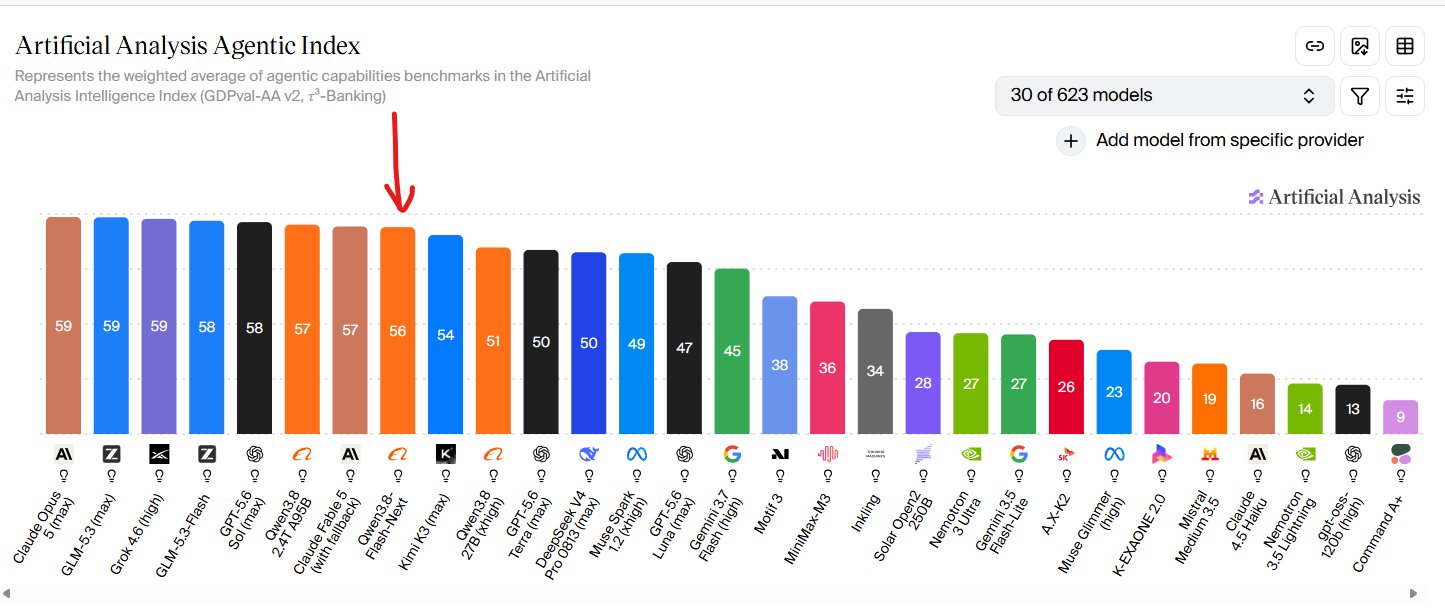
Qwen3.8-Flash-Next scores 56 on Artificial Analysis’ Intelligence Index, far above the median score of 29 for open-weight models of a similar size.
This is what’s so incredible about it — it’s not the absolute smartest model out there — but it’s hands down one of the most efficient.
We saw this with GLM-5.3 too — companies are no longer so obsessed with absolute intelligence and parameter size — they are now competing in radical efficiency and innovative training techniques.
And it’s just a new model or typical update — it’s actually a stepping stone for the future generation.
Qwen 3.8 Flash Next is actually an experimental preview of the upcoming revolutionary Qwen 4 model.
And Alibaba (the makers) refused to follow the same old formula of training a bigger model and spending more and more on compute.
They didn’t focus on parameters — instead they redesigned several fundamental parts of the model from the ground up to drastically improve the efficiency.
Qwen3.8-Flash-Next’s 62.5% score on SWE-bench Pro, compared with Claude Opus 4.6 Max’s score of 53.4%, demonstrates the model’s highly competitive performance on complex, real-world software engineering tasks
And what you get is a model with frontier-level benchmark performance that can run entirely on local hardware and costs dramatically less to train than its predecessor.
You can run it entirely locally
Qwen3.8-Flash-Next is also open-weight, meaning you can download and run quantized versions without relying on a cloud API.
Community MLX builds are already running it on Apple Silicon.
Current conventional 4-bit builds generally require around 100GB of unified memory — but you can run it on much less powerful devices by increasing the quantization.
Apple’s new M5 Ultra Mac Studio is particularly powerful for running models locally. You can configure it with as much as 512GB of unified memory and 1.2TB/s of memory bandwidth.
So with enough memory you can run Qwen3.8-Flash-Next completely locally: no per-token API fees and no private documents or prompts leaving your computer.
It cost roughly one-ninth as much to train
Alibaba says training Qwen3.8-Flash-Next needed only around one-ninth of the training cost of Qwen3.7-Plus — even with the newer model outperforming its predecessor across several important areas.
That efficiency comes from a radically different architecture.
The model’s main network contains 125 billion parameters, accompanied by roughly 51 billion parameters of N-gram embeddings.
But it only activates around 6 billion parameters per token.
That’s possible because Qwen3.8-Flash-Next uses a sparse Mixture-of-Experts (MoE) architecture. Instead of running the entire network for every token, it dynamically routes each token through only the experts required for that particular computation.
The result is enormous overall model capacity without paying the computational cost of activating everything simultaneously.
Completely rebuilt architecture
MoE isn’t the only major change.
Qwen3.8-Flash-Next introduces fundamental changes across attention, residual connections, embeddings and optimization.
Its hybrid attention architecture combines Gated DeltaNet, a form of linear attention, with a new mechanism called Qwen Sparse Attention (QSA).
Rather than repeatedly examining everything inside an enormous context window, QSA uses a lightweight indexer to locate relevant information.
That helps the model maintain high inference speeds and relatively low memory requirements across extremely long prompts. It natively supports 262,144 tokens, extendable to 1 million tokens using YaRN.
Alibaba has also introduced Gated Residual, which expands the residual stream into four dynamically controlled branches, and billions of N-gram embedding parameters that increase capacity without requiring equivalent active computation.
It all comes down to one thing:
More intelligence without proportionally more compute.
This is really a preview of Qwen 4
And this might be the most important part.
Alibaba calls Qwen3.8-Flash-Next an early preview of the architecture that will power Qwen4.
So as a developer you get to test these ideas before the full Qwen4 family arrives.
The direction is pretty clear.
For years AI companies mostly chased better models by adding more parameters and more compute.
Qwen3.8-Flash-Next asks a different question.
What if you could get much more intelligence from much less compute?
If this really is the foundation for Qwen4 — things are about to get very interesting.