
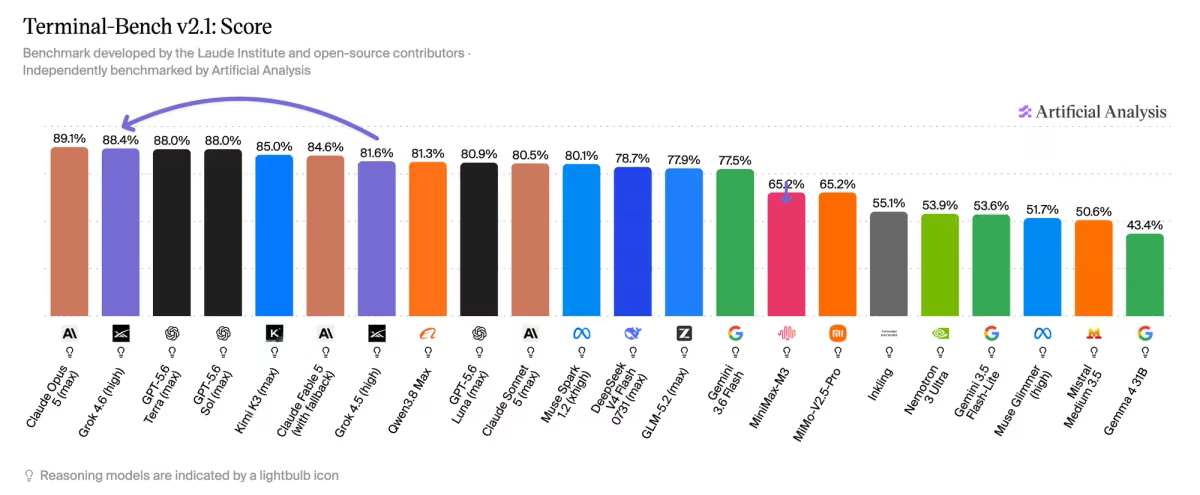
The new Grok 4.6 model is amazingly good at coding.
Elon Musk’s xAI trained it on billions of real developer interactions and and code editing patterns — thanks to their recent acquisition of the Cursor IDE.
It now performs as good as top-tier models like GPT-5.6 and Opus 5 the vast majority of the time — yet it’s multiple times cheaper.
And Grok 4.7 is already coming very soon too — with big promises of it “exceeding all current models” from Musk.
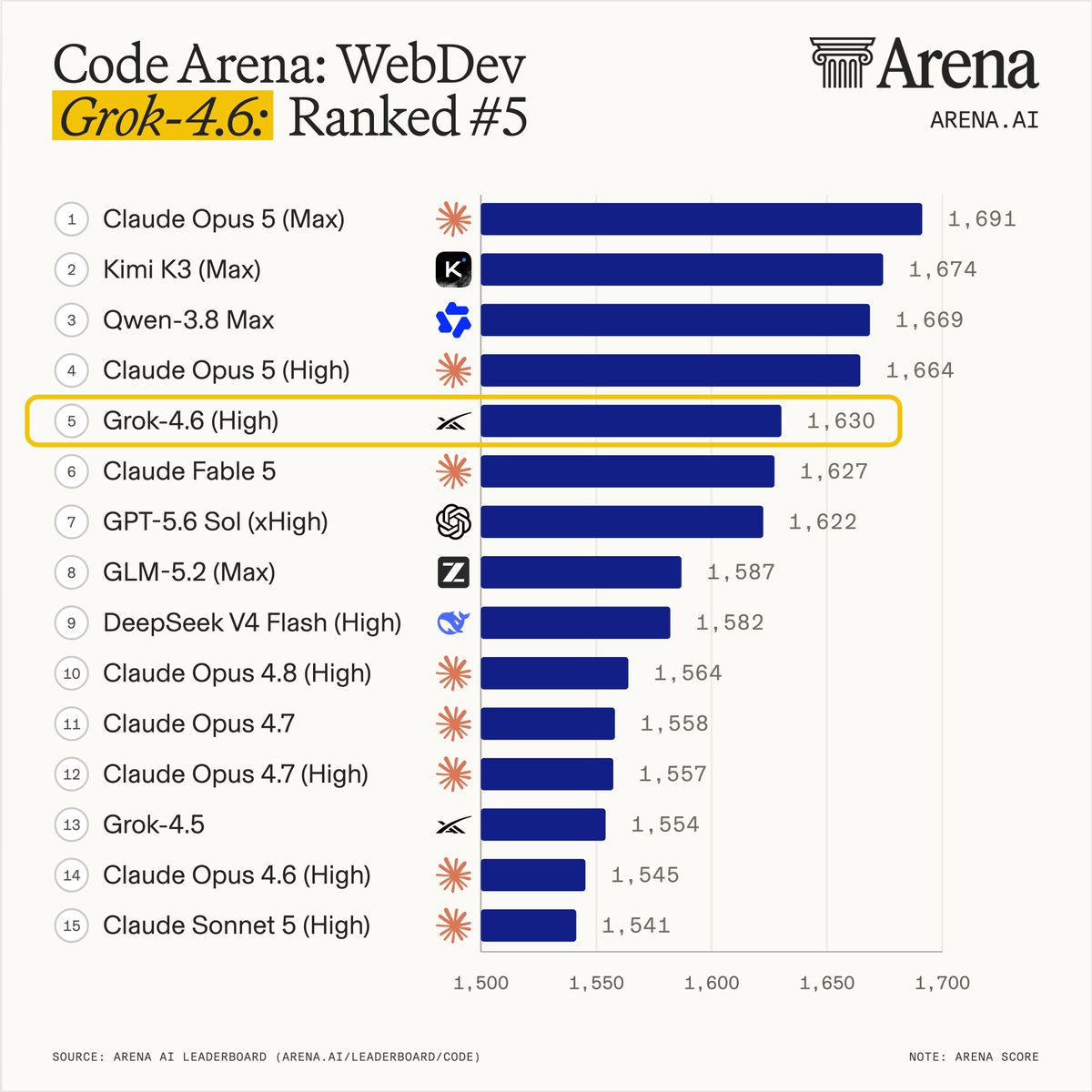
Grok 4.6 scores an incredible 5th place on the AI Arena Leaderboard — despite being much cheaper than most of the model above it — only Qwen 3.8 Max is as cheap as it (same price).
On CursorBench v3.2, Grok 4.6 Extra High took the top spot with 70.8%, edging out Fable 5 Max at 70.5% and Opus 5 Max at 70.0%, while comfortably beating GPT-5.6 Sol Max at 67.2%
It comes with major upgrades in software engineering and long-horizon agentic coding.
Grok 4.6 combines frontier-level benchmark performance with aggressive pricing, long-running agent capabilities, deep Cursor integration, and stronger visual application development.
It can carry out the most complex tasks in the most complicated codebases imaginable.
Grok 4.6 is designed to execute extended, multi-step workflows. It can use tools, navigate large codebases, research unfamiliar topics and maintain context across long sequences of actions.
It also has much stronger self-verification.
Grok 4.6 is much better at checking its own homework: xAI reports more self-testing and verification on long-running tasks, alongside a jump from 54% to 65.9% on DeepSWE v1.1 and 47.1% to 57.5% on APEX-Agents versus Grok 4.5.
And this fixes one of the biggest weaknesses of autonomous AI agents: small mistakes accumulating across long workflows.
It also has a 500K context window — something I was really surprised about — cause these days 1 million is like the standard. But it’s still quite a lot.
With a 500,000-token context window, Grok 4.6 can keep roughly 375,000 words of text in context at once—equivalent to about five full-length novels—giving long-running agents far more room to work without losing the plot
It’s a lot more intelligent than it’s predecessor — even though it costs exactly the same — giving much more intelligent per unit cost.
It scores 61 on the Artificial Analysis Intelligence Index, up from Grok 4.5’s 56 and placing it among the highest-performing models in SpaceXAI’s published comparison.
Grok 4.6 was trained from the ground up on the actual real-world code and developer patterns from Cursor — so it could achieve the best results possible as a coding agent.
Its training included high-quality engineering data and supervised fine-tuning trajectories covering software engineering, reasoning, STEM and agent workflows.
It used sophisticated techniques like reinforcement learning to deeply understand how we actually code and work as developers.
SpaceXAI then applied agentic reinforcement learning across environments including general coding, kernel optimization, web development and computer-aided design.
It also amazing at coding with visual input data — which makes it especially powerful for web design and frontend development.
Give it a high-level product idea, and the model can establish an application’s structure and visual language, implement its core interactions and then refine the result through subsequent iterations.
You can build unbelievably sophisticated games and 3d web experiences with very little prompting.
You can just describe what you want to build and let the Grok-4.6-powered agent work out all the architecture, interface and implementation.
xAI is still a serious contender in the AI race — and Grok 4.6 is definitely worth giving a try, for coding and many other use cases.