
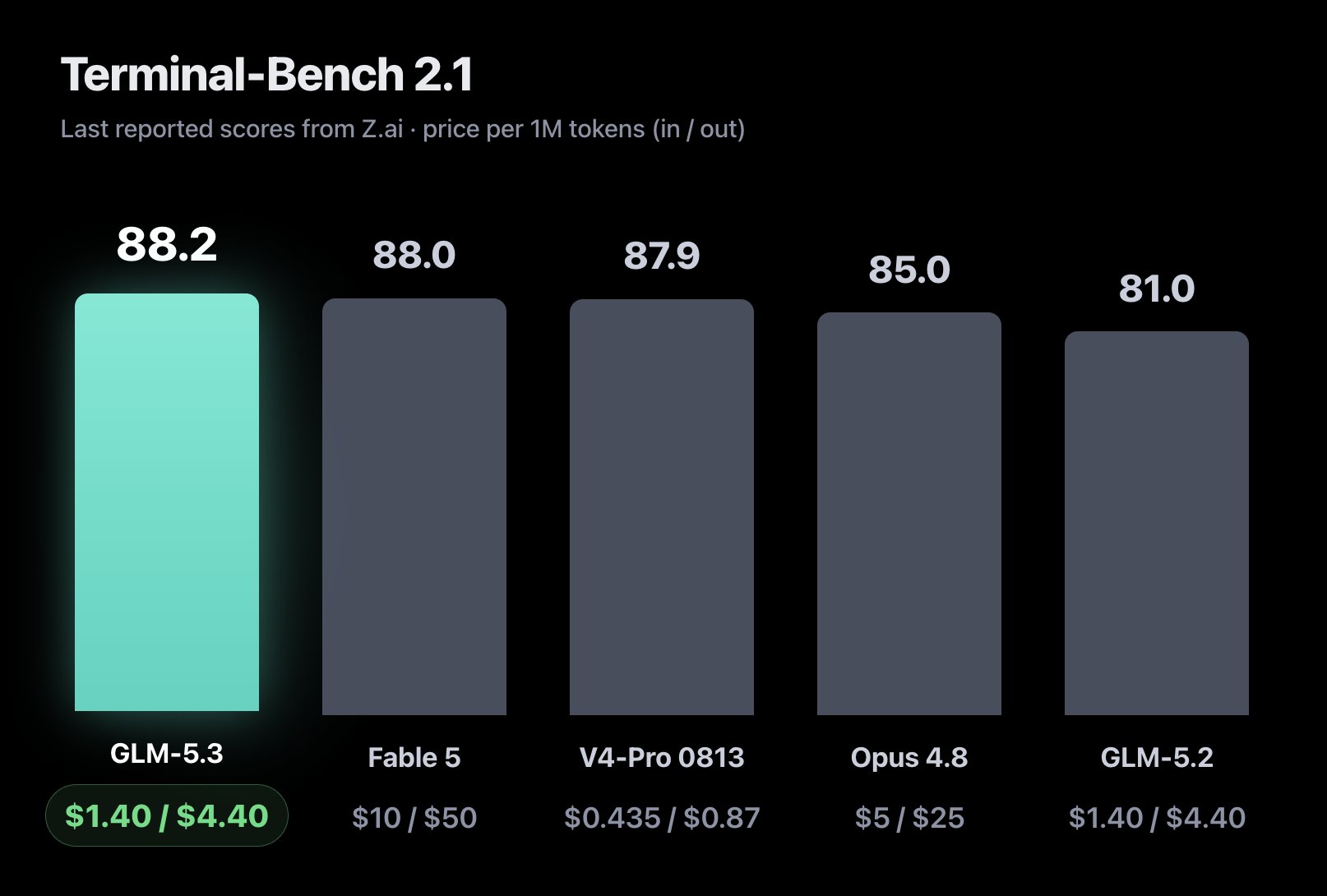
GLM-5.3 is a very unconventional upgrade — no one should ignore this and what it means.
Z.ai (the makers) refused to follow the same old formula of training a bigger model and spending more and more on compute.
Like as far as weights and parameters go, this is the exact same model as GLM-5.2 (and still open-source btw).
But somehow it’s just better in every single way — with an unbelievable 50% performance leap and scary coding and hacking ability that now surpasses even Claude Mythos 5.
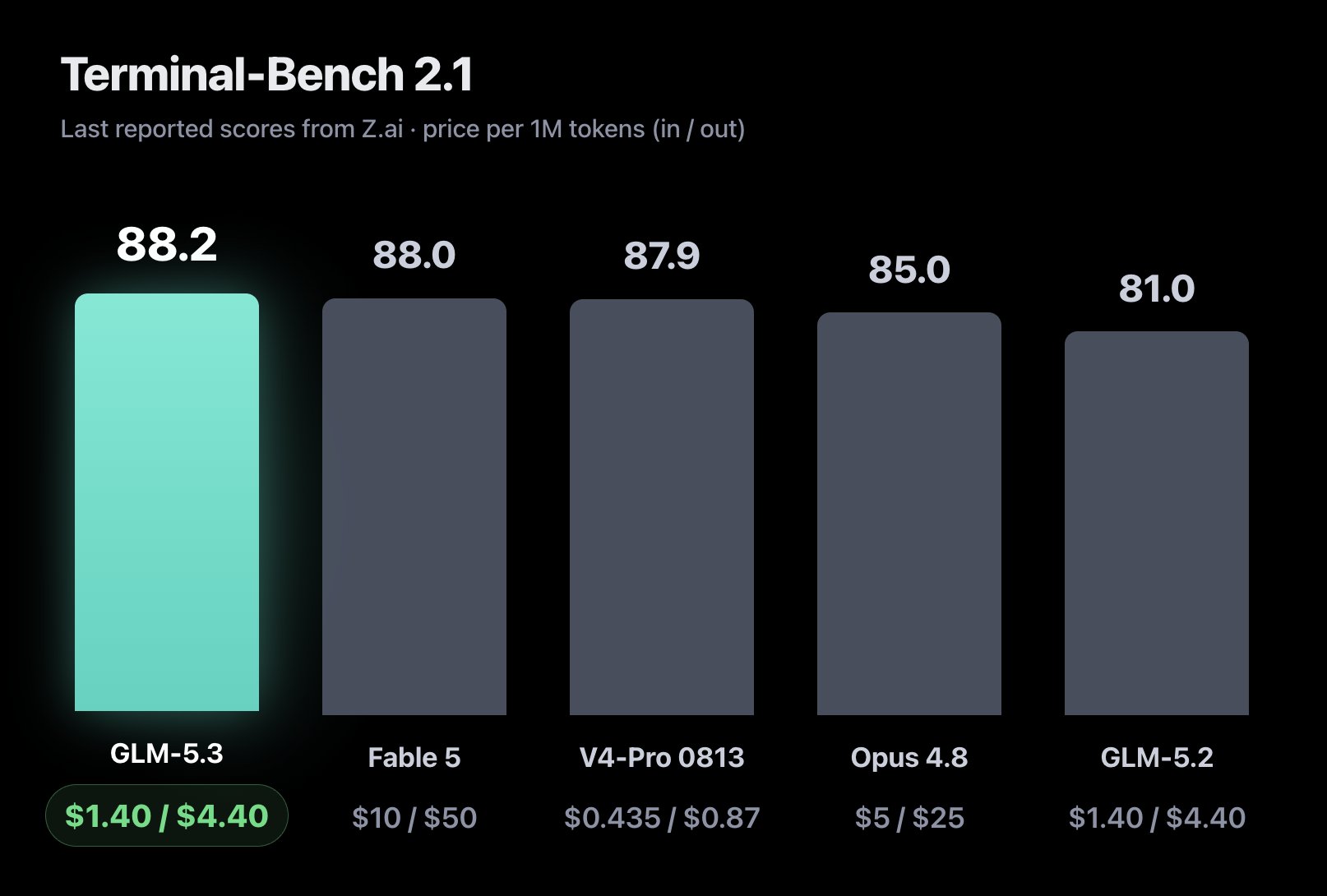
GLM-5.3 beats every single model in the official Terminal-Bench 2.1 benchmark — include Fable 5 — despite being several times cheaper:
On DeepSWE, GLM-5.3 scored 66.9, nearly matching Kimi K3 (67.5) and outperforming GLM-5.2 (46.2), while remaining competitive with Fable 5 (69.7) and GPT-5.6 Sol (72.7).
They didn’t build a new model from scratch — they focused entirely on how to make the model learn better from existing data — using sophisticated techniques like reinforcement learning and environment scaling.
A novel approach that has now paid off massively.
Open-source GLM-5.3 goes toe-to-toe with Fable 5 in coding and every other area — despite being several times cheaper:
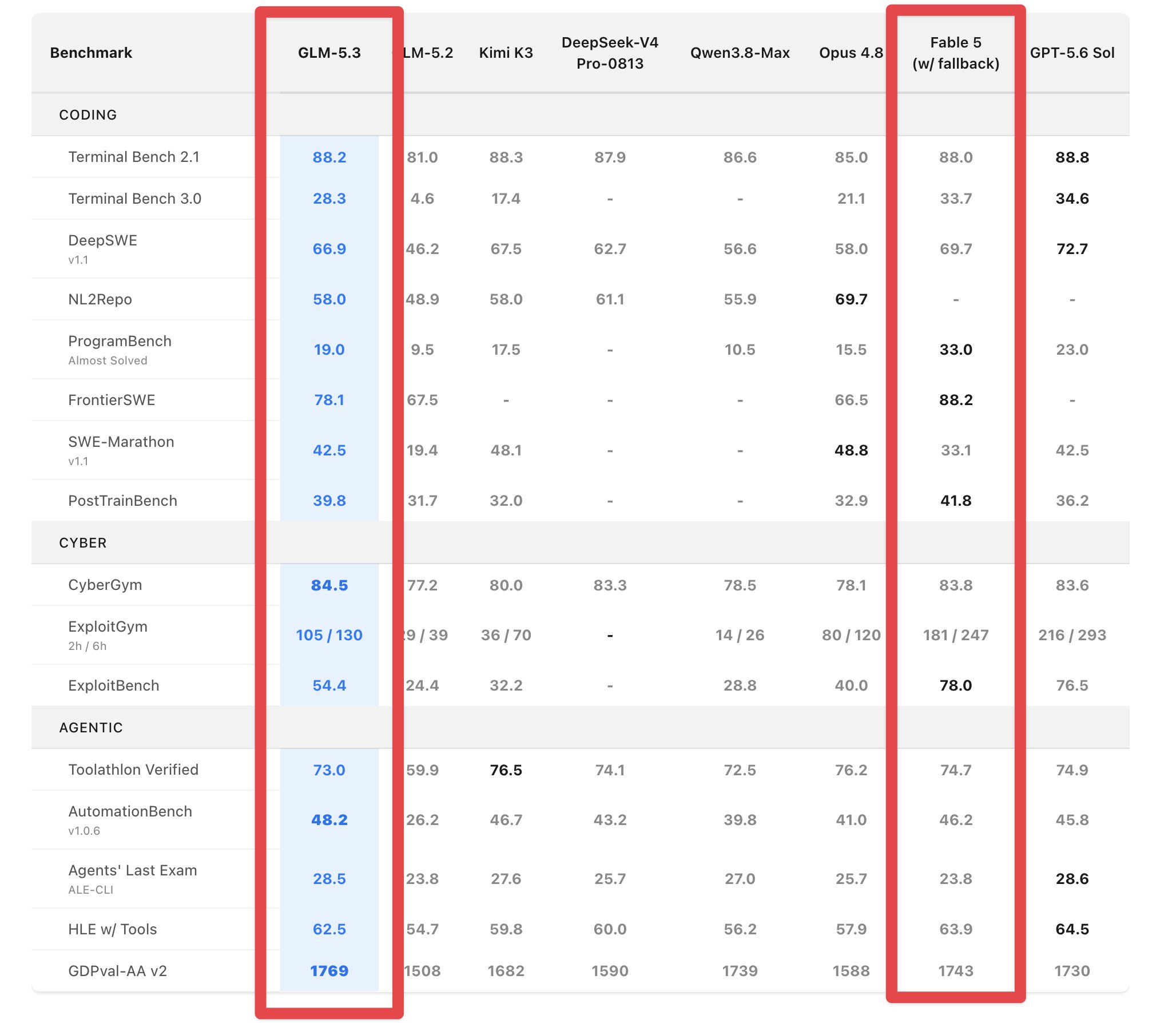
On Agents’ Last Exam (CLI), GLM-5.3 posted the highest score at 28.5, narrowly surpassing GPT-5.6 Sol (28.6) and Kimi K3 (27.6) to lead the benchmark.
It’s challenging the long-standing believe that better AI performance needs larger base models.
From GLM-5.3 we are seeing that we can get serious results from simply coming with new ways to improve how models learn after pre-training.
We could see major gains across board as more and more AI companies consider this different approach.
The cybersecurity performance is incredible.
GLM-5.3 achieved 84.5% on the CyberGym benchmark, a test designed to evaluate vulnerability discovery, software security analysis, and exploit-chain reasoning, surpassing both Claude Mythos 5 and GPT-5.6 Sol on the benchmark.
It’s very strong at:
- Vulnerability discovery
- Security auditing
- Root-cause analysis
- Multi-step software reasoning
GLM-powered systems identified thousands of real-world software vulnerabilities during internal testing, including critical security flaws in widely used developer tools.
They also designed GLM-5.3 with autonomous agents in mind.
The model supports:
- 1 million token context
- 128,000 token output length
This allows it to work across large codebases, lengthy technical documents, and multi-stage workflows without losing context.
Just as important, it also completes tasks using much fewer output tokens than GLM-5.2 while achieving higher accuracy.
That combination means:
- Lower inference costs
- Faster execution
- Better agent efficiency
- Improved performance on long-running tasks
And as we find ourselves using AI more and more for software engineering, efficiency is becoming just as important as raw intelligence.
GLM-5.3 also changes how reasoning works.
You can turn off reasoning anymore like in some other models — you can only choose between Low, High, and Max.
This reflects a growing industry trend where reasoning is treated as a core capability rather than an optional feature.
The question is no longer whether the model should think, but how much compute should be allocated to solving a problem.
Z.ai also remains committed to releasing model weights publicly.
But because of GLM-5.3’s strong cybersecurity abilities, they’ve had to introduce a new Open Source Shield Initiative — which is meant to:
- Keep defensive security research open
- Support code auditing and vulnerability detection
- Restrict access to high-risk offensive exploitation capabilities
This helps to balance openness with responsible deployment.
GLM-5.3 may ultimately be remembered less for its benchmark scores and more for what it represents.
It shows us that massive gains are still possible without training a new base model.
It sets a new bar for AI-driven cybersecurity research. And it is optimized for the future of long-horizon autonomous agents.
If earlier AI progress was defined by scaling pretraining, GLM-5.3 is showing us that next era could be all about scaling post-training instead.