
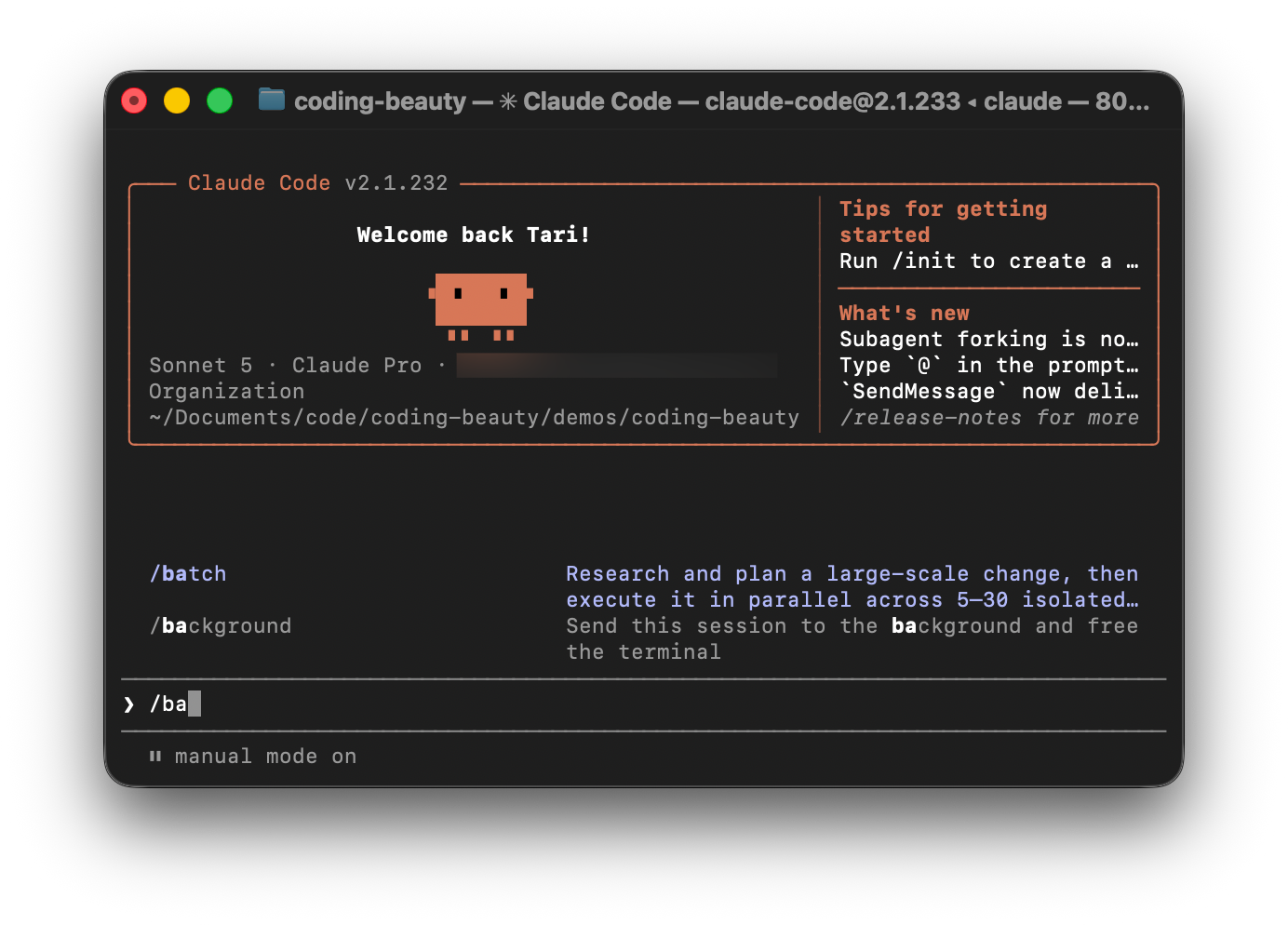
This Claude Code command is amazing.
It’s somehow like the multi-agent teams feature — but much simpler and more straightforward.
It’s perfect for those large-scale changes that can easily be broken down into smaller tasks — like mass refactoring and codebase migration.
It spins up multiple AI agents to work simultaneously across the codebase — giving you an immense boost in productivity.
Let’s look at the key features that make it so invaluable when working with Claude Code — from autonomous testing and pull requests, to how it combines brilliantly with other Claude Code commands to build a comprehensive engineering workflow.
1. Multi-agent task decomposition: ship large-scale code changes faster
The foundation of /batch is its ability to break large requests into smaller, independent units of work.
When you invoke /batch, Claude Code:
- Analyzes the repository.
- Understands the requested objective.
- Identifies logical boundaries within the codebase.
- Decomposes the work into 5–30 independent work units.
Rather than editing files sequentially, Claude distributes work across multiple agents that can operate in parallel.
For example, a framework migration might be divided into:
- Shared UI components
- Authentication modules
- Routing logic
- API integrations
- Testing infrastructure
By separating work into distinct scopes, /batch can scale far beyond the limitations of a traditional single-agent workflow.
2. The /batch and /simplify power combo
One of the more interesting aspects of /batch is how it complements Claude Code’s /simplify command.
While /simplify focuses on reducing complexity and unnecessary abstractions, /batch can coordinate improvements across an entire codebase.
The combination gives us several advantages:
- Identifies overly complex patterns at scale.
- Reduces unnecessary abstractions and indirection.
- Improves code readability and maintainability.
- Creates greater consistency across modules.
- Eliminates repetitive manual refactoring work.
Instead of simplifying files one by one, you can use /batch to coordinate the effort across dozens of components simultaneously. This makes large-scale codebase cleanup and standardization significantly faster and more manageable.
3. Git worktree isolation: parallelize without conflicts
A key feature of /batch is its use of Git worktrees.
Every subagent receives its own isolated worktree instead of sharing a single working directory.
This enables:
- Concurrent development
- Independent validation
- Isolated dependency management
- Reduced merge conflicts
Because each worker operates in its own environment, changes made by one agent do not interfere with another.
A component migration can run in one worktree while another agent updates tests or refactors utilities elsewhere in the repository.
This isolation is what makes large-scale parallel execution practical and reliable.
4. Autonomous testing and pull requests
/batch is more than a code-editing tool.
Each subagent behaves like an autonomous developer responsible for its assigned scope.
Subagents can:
- Implement code changes
- Run test suites
- Detect failures
- Fix localized issues
- Validate completed work
- Create commits or pull requests
Instead of producing one massive repository-wide change, /batch generates smaller, self-contained outputs that are easier to review and merge.
The result is less manual coordination and a cleaner development workflow.
5. Plan-first execution
Before making any changes, /batch generates a structured execution plan.
The plan outlines:
- How the task was divided
- Which files or directories belong to each work unit
- The responsibilities assigned to each subagent
- The proposed transformation for each area of the codebase
Developers review and approve the plan before execution begins.
This approval stage:
- Provides visibility into the process
- Prevents unexpected repository-wide changes
- Keeps humans in control of major modifications
Rather than blindly applying edits, /batch follows a plan-first approach designed for large-scale engineering work.
Final thoughts
Claude Code’s /batch command represents the broader shift single-agent coding assistance to coordinated multi-agent software engineering.
With key features like:
- Intelligent task decomposition
- Parallel AI execution
- Git worktree isolation
- Autonomous testing
- Pull request generation
- Human approval checkpoints
It enables repository-wide transformations at a scale that would traditionally require significant manual effort.
Software is no longer being built by a single AI agent, but now by a coordinated systems of specialized agents working together toward a common objective.