
This is HUGE.
Google’s new Gemini 3.7 Flash is absolutely insane.
It even dominated Claude Sonnet 5 and GPT-5.6 Terra — it’s the best & fastest mid-tier coding model in the world right now.
It literally jumped 11 good places in the AI Arena Leaderboard — now even beating models like Opus 4.8 and Grok 4.5 — despite being several times cheaper and faster.
It’s so amazing at software engineering, web design, and UI generation.
Gemini 3.7 Flash achieved 65.3% on DeepSWE v1.1—up dramatically from Gemini 3.6 Flash’s 48.6% and ahead of Claude Sonnet 5’s 49.7% and GPT-5.6 Terra’s roughly 52–54% results on the same benchmark, establishing a new high-water mark for autonomous software engineering.
Gemini 3.7 Flash has by far the best Time per Intelligence of any model of this intelligence level:
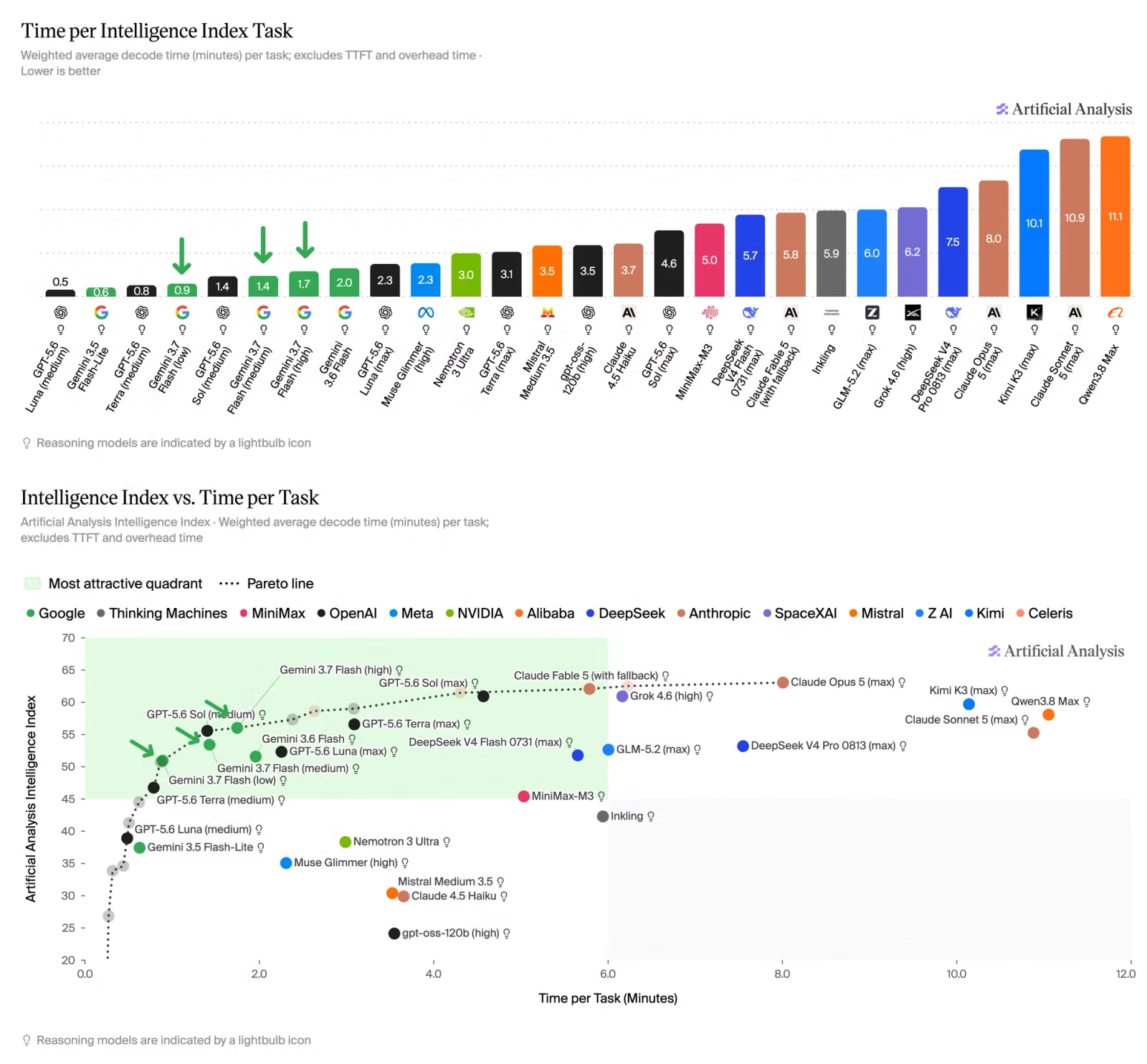
Google’s Gemini 3.7 Flash delivers a breakthrough intelligence-to-speed ratio, hitting a peak output speed of roughly 340 tokens per second while scoring 56 on the Artificial Analysis Intelligence Index—outperforming several pricier flagship peers while finishing multi-step workflows up to 40% faster
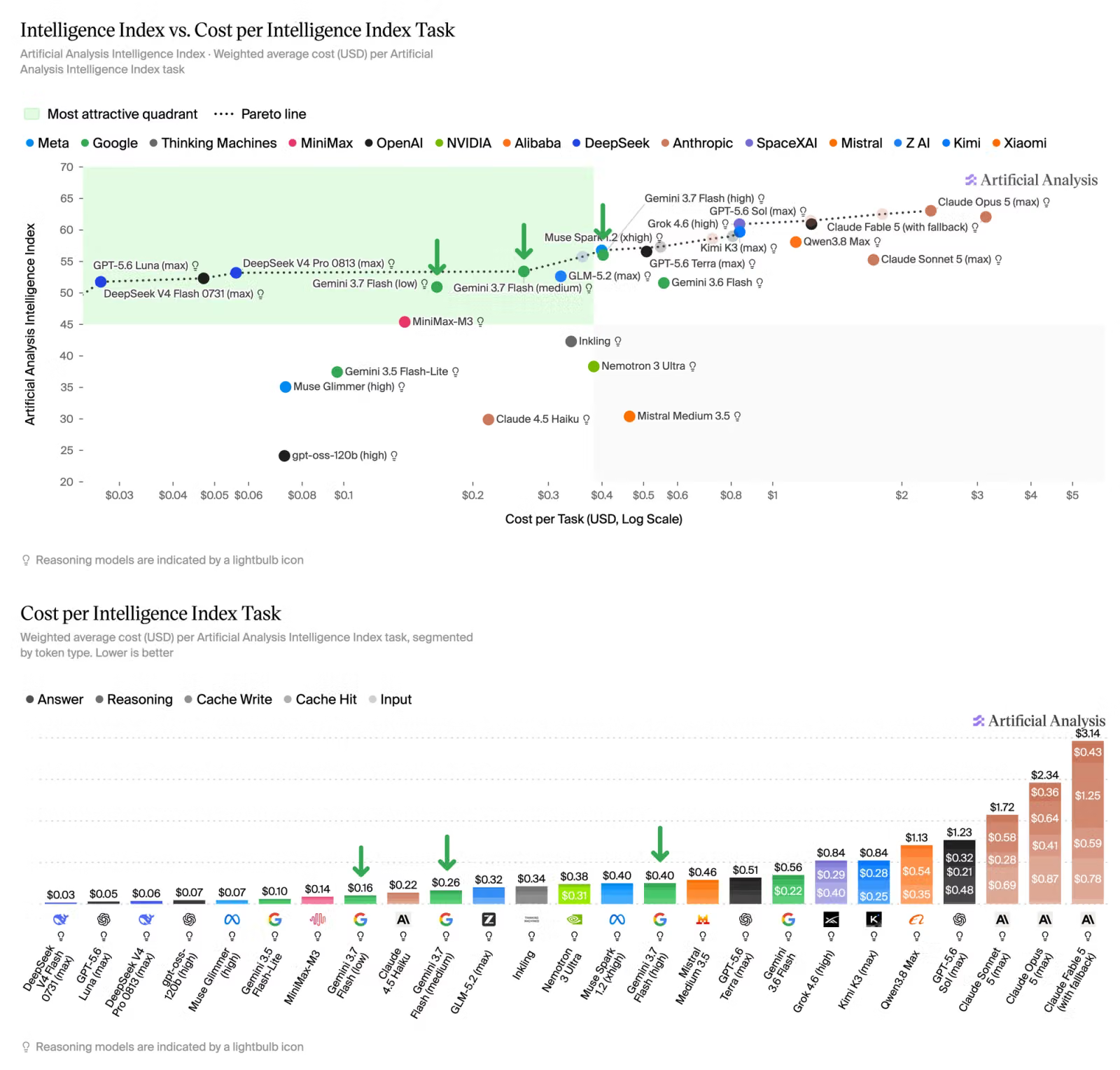
It costs so much less than all these other models on the same level of intelligence — you won’t believe how cheap it is right now.
Gemini 3.7 Flash has by far the best Cost per Intelligence of any model of this intelligence level:
Smarter agentic planning — “diligent” thinking
The reasoning and planning have gotten so much more sophisticated.
Instead of immediately generating a response, the model spends more time planning, reasoning, and coordinating tools before taking action.
It thinks more diligently, putting in more effort into multi-step planning and tool calls. A more disciplined execution means less manual oversight and fewer retries across engineering workflows.
This gives you:
- Better upfront planning for complex tasks
- Self-correction when code or tool calls fail
- Recovery from dead ends without getting stuck in retry loops
- Stronger tool orchestration across multi-step workflows
- Intent clarification when instructions are ambiguous
It doesn’t make risky assumptions of things it’s not sure about — it pauses and ask the right question before continuing.
Which makes a much more reliable coding partner.
Massive software engineering gains
Nobody can look down on Gemini when it comes to coding anymore.
Gemini 3.7 Flash achieved 65.3% on DeepSWE v1.1—up dramatically from Gemini 3.6 Flash’s 48.6% and ahead of Claude Sonnet 5’s 49.7% and GPT-5.6 Terra’s roughly 52–54% results on the same benchmark, establishing a new high-water mark for autonomous software engineering.
3.7 Flash outperforms other frontier models like Sonnet 5 and GPT-5.6 Terra is key software engineering abilities — despite being multiple times cheaper.
It’s been such a massive upgrade:
Benchmark Performance:
65.3% on DeepSWE v1.1
- Up from 48.6% in Gemini 3.6 Flash
- Measures complex, long-horizon software engineering tasks
43.6% on FrontierCode 1.1
- Evaluates first-pass coding accuracy
- Tests real-world engineering capabilities
These gains translate into real meaningful improvements for you as a developer:
- Better understanding of large codebases
- Stronger debugging abilities
- More accurate feature implementation
- Improved multi-file reasoning
- Higher-quality code on the first attempt
Exceptional web dev & frontend design ability
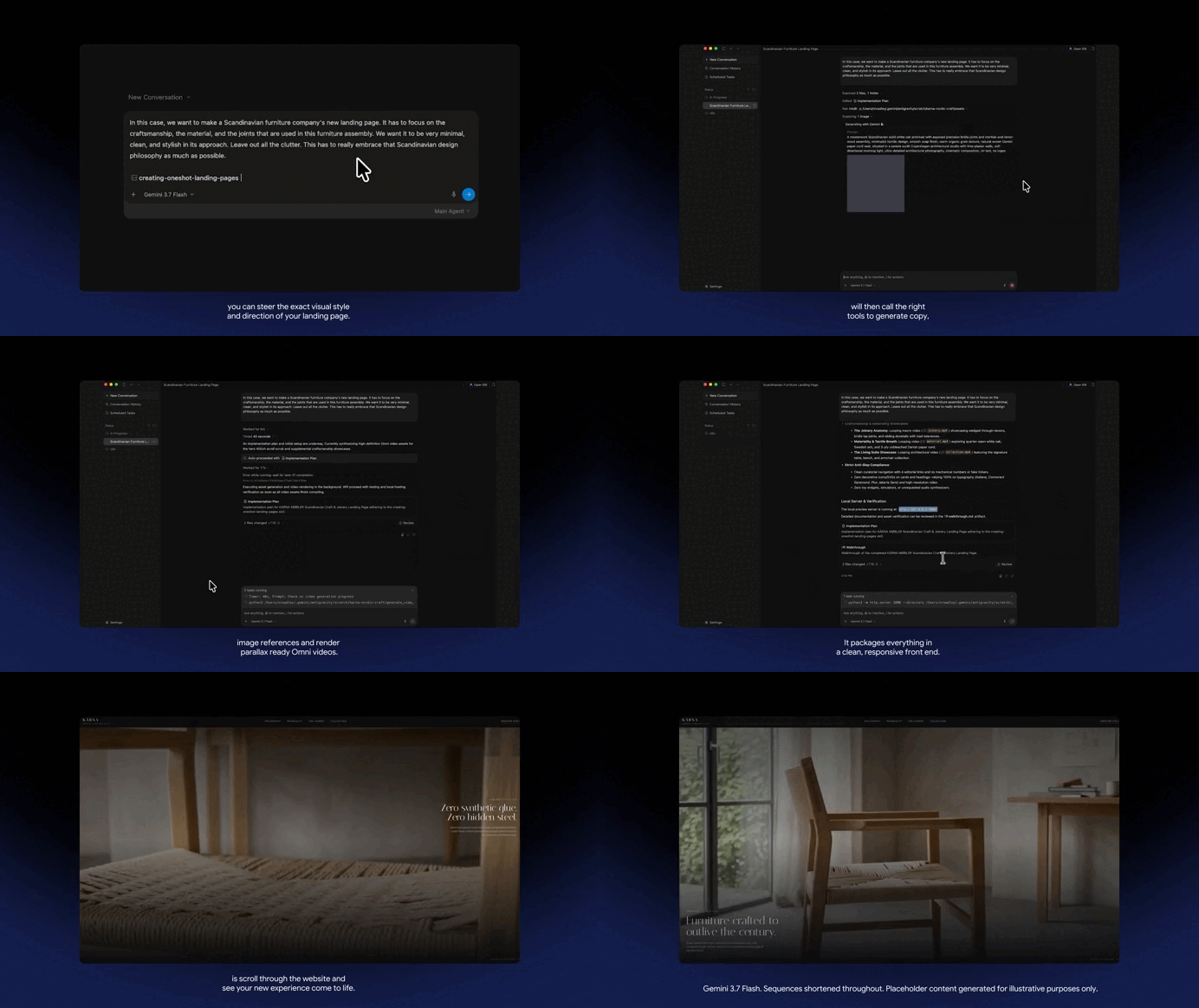
Frontend generation is becoming one of the most competitive areas in AI — and Gemini 3.7 Flash is now among the strongest performers.
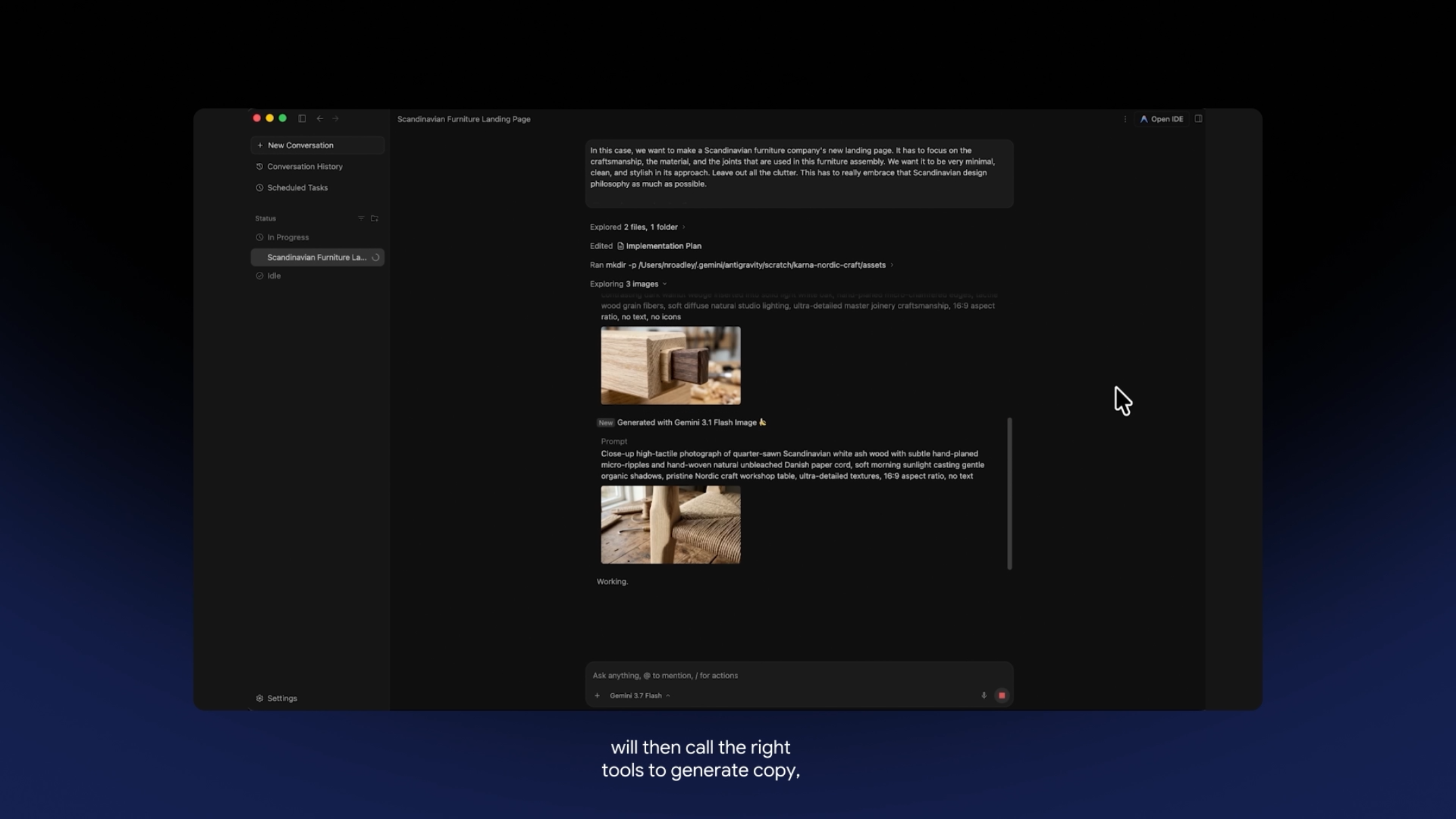
Gemini 3.7 Flash generating a world class landing page with posh visual effects from scratch:
Frontend Benchmarks:
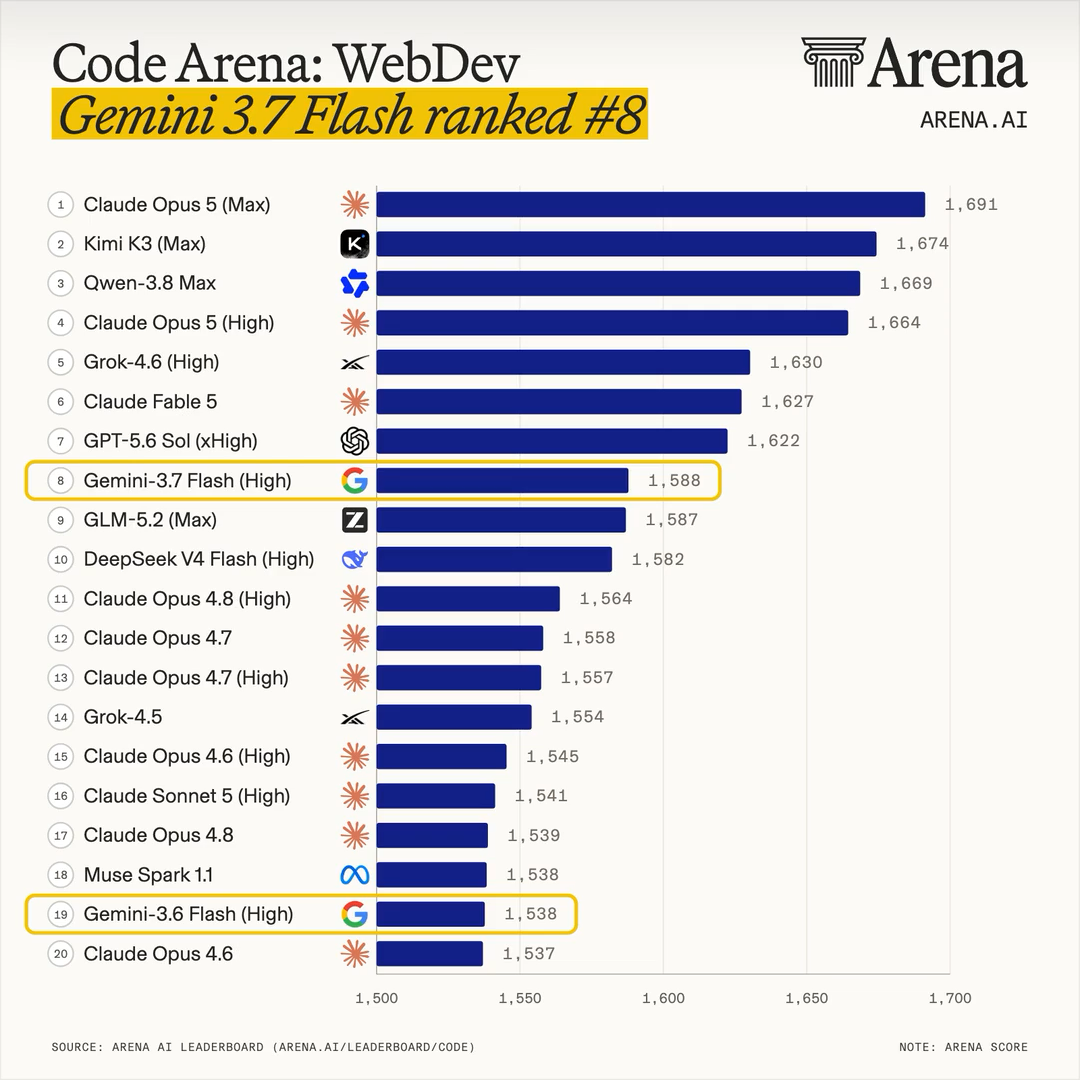
- 1588 Elo on WebDev Arena
- 1588 Elo on Code Arena
These scores place Gemini 3.7 Flash ahead of competing models like Claude Sonnet 5 and GPT-5.6 Terra in frontend and full-stack application generation.
And these benchmarks evaluate more than visual appearance. High-performing models must create:
- Responsive layouts
- Multi-component interfaces
- Consistent design systems
- Functional application logic
- Production-quality user experiences
As someone building real-world products, this means fewer revisions and better results for you from the very first prompt.
Incredible UI generation ability
You can give it:
- Wireframes
- Screenshots
- Design systems
- Existing interfaces
- Product mockups
The model can then generate functional applications that closely match the provided designs.
Instead of hallucinating generic layouts, it is far better at preserving structure, styling, and user experience patterns.
The result:
- Fewer prompts
- Less back-and-forth
- Faster prototyping
- Quicker path to production-ready applications
Industry-leading Pricing
This is hands-down one of the biggest selling points.
Introductory Pricing (through December 31, 2026)
- $0.75 per million input tokens
- $3.75 per million output tokens
Standard Pricing (starting January 1, 2027)
- $1.50 per million input tokens
- $7.50 per million output tokens
Even at standard pricing, Gemini 3.7 Flash remains highly competitive.
At launch pricing, it is:
- More than 60% cheaper than Claude Sonnet 5
- More than 60% cheaper than GPT-5.6 Terra
- Competitive or superior across several coding and web development benchmarks
This combination of performance and affordability makes it one of the strongest value propositions in the AI market today.
Far more than just a routine upgrade
It gives us major advances in:
- Agentic planning
- Self-correction
- Software engineering
- Web development
- Frontend design
Combined with aggressive pricing, Gemini 3.7 Flash sets a new benchmark for cost-efficient AI.
For developers and startups building AI-powered products, it’s one of the most compelling models available today.