

This is huge.
Claude Sonnet 5 is seriously revolutionary.
A Claude model that matches up to the most powerful and intelligent models out there — yet several times lighter, cheaper, and faster.

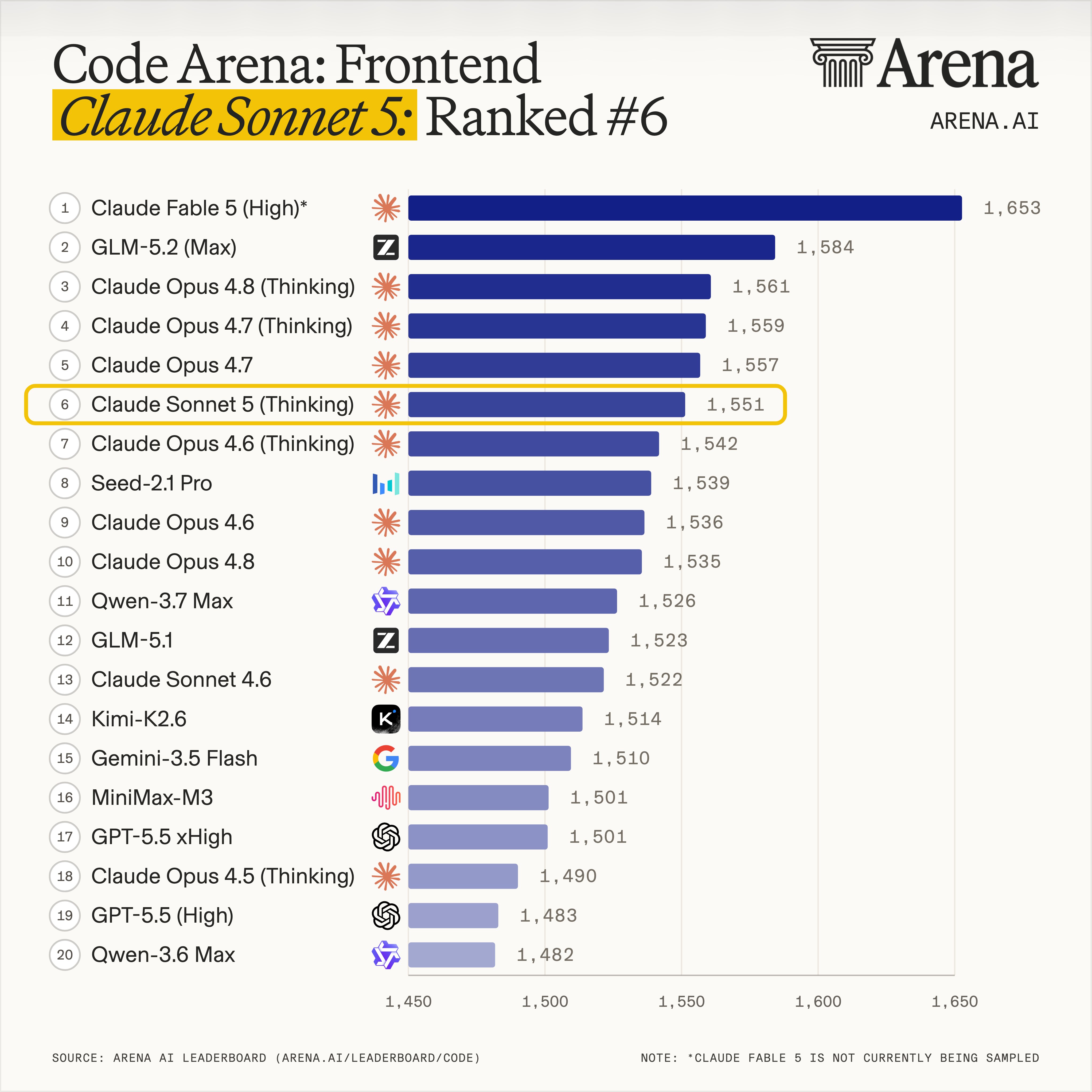
It literally dominated every single non-Claude model in several reputable benchmarks — and shockingly matched up to Opus 4.8.
Only Fable 5 was significantly better in the Arena AI leaderboard.
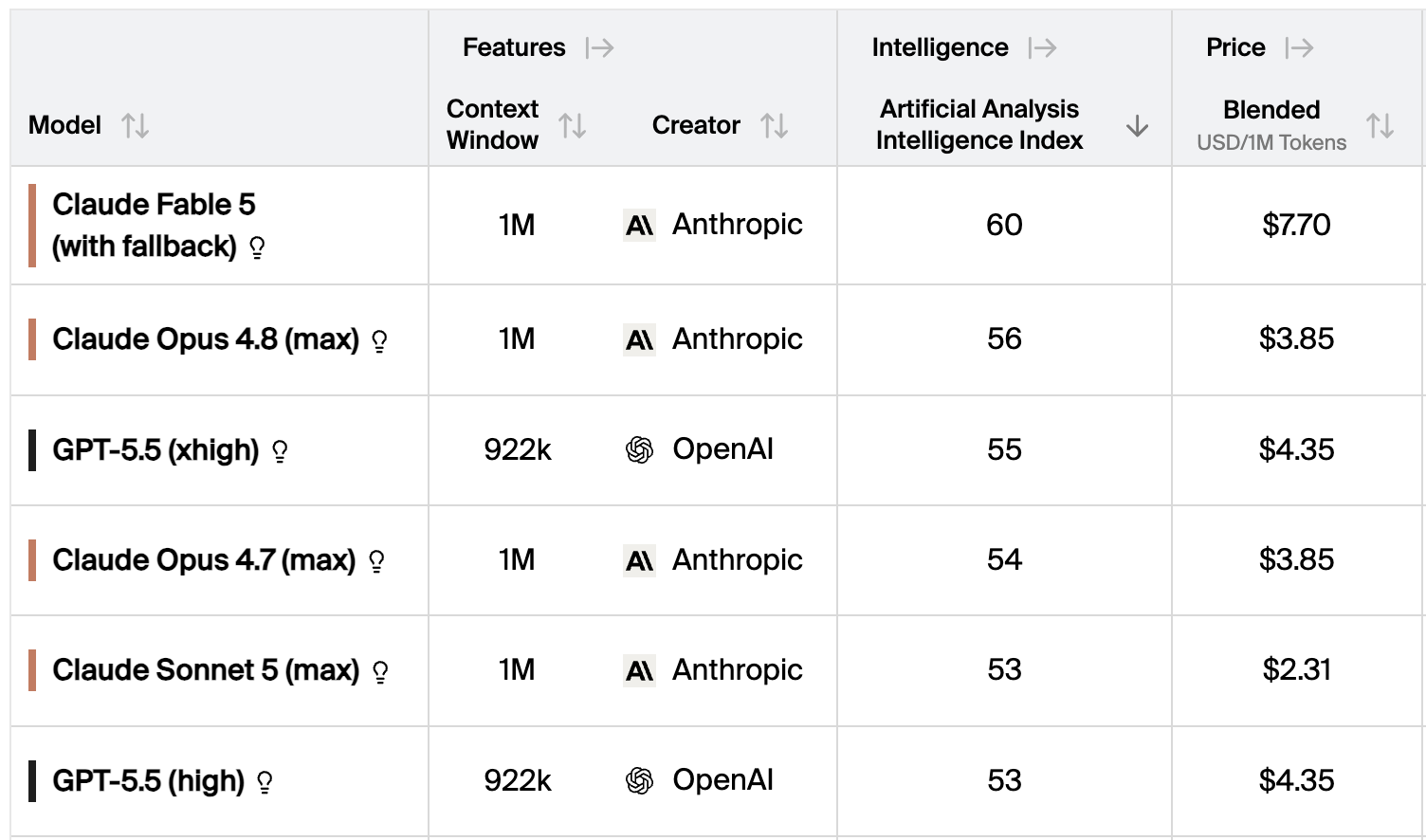
The normal, non-mini version GPT-5.5 could only beat out Sonnet 5 at its absolute maximum thinking effort (xhigh) on the Artificial Analysis Leaderboard:
And it’s not just about the massively improved intelligence density or efficiency.
Sonnet 5 also fixes a major issue that many developers have faced when dealing with Claude models.
The self-improving and autonomous ability is on another level.
All this with ultra-competitive pricing that will give us massive savings in token costs.
1. Intelligence autonomous multi-step execution and self-verification
This is one of the biggest upgrades in Sonnet 5.
It’s now so much better at carrying out extended sequences of work without constant supervision.
By leaping more than 13 percentage points to hit 80.4% on Terminal-Bench 2.1, Claude Sonnet 5 represents the largest terminal-based engineering jump in the lineup’s history, completely closing the gap with the flagship Opus 4.8
Previous Claude models were excellent at planning — but they still struggled to reliably follow through on complicated workflows involving debugging, testing, and iterative refinement. Sonnet 5 is build from the ground up to stay on track.
The new and improved self-verification is on another level.
It now verifies its own work from top to bottom before returning it.
Instead of generating a fix and hoping it’s correct, the model can reproduce a bug, implement a solution, test the fix, temporarily remove it to confirm the issue returns, and then restore the working version — all without being explicitly instructed to perform each step.
Proactively fixing problems and edge cases you would never have considered.
2. One million token context — but somehow even better
Sonnet 5 also uses an incredible 1 million token context window — making it practical for us to work across enormous codebases, lengthy documents, and large enterprise knowledge repositories.
But here’s what makes it such a big deal now — Anthropic has completely removed the pricing penalty that previously applied to very large prompts.
Earlier Sonnet models charged premium rates beyond 200,000 tokens — but Sonnet 5 offers standard pricing across the entire one-million-token context window, making large-context applications far more economical.
3. Massive improvements in agentic coding capabilities
Anthropic has also made enormous progress in agentic coding.
Claude Sonnet 5 narrows the gap to flagship-level intelligence by surging to a 63.2% pass rate on SWE-bench Pro—marking a major 5.1 percentage point leap over Sonnet 4.6 and landing within striking distance of Opus 4.8’s field-leading 69.2%.
Compared with both Claude Sonnet 4.6 and even the more expensive Claude Opus 4.8, Sonnet 5 is significantly better at handling extended software engineering workflows with minimal human intervention.
It can maintain context across long coding sessions, make coordinated changes across multiple files, recover from mistakes — all while rapidly progressing toward the larger objective.
A super-powered collaborative engineer capable of managing the most substantial development tasks.
4. Adaptive thinking by default
One of the most interesting changes happens before the model even begins generating a response.
Rather than immediately producing an answer — Sonnet 5 now uses adaptive thinking by default.
It automatically decides how much reasoning a problem requires, spending more time on difficult coding and analytical tasks while responding quickly to simpler requests.
We can also control this behavior, adjusting the reasoning effort from Low to Extra High depending on whether they prioritize speed or accuracy.
At its highest settings, Sonnet 5 reaches reasoning and coding performance comparable to Claude Opus while maintaining the efficiency expected from the Sonnet family.
5. Built-in real-time cybersecurity guardrails
Claude models have been getting scary good at finding vulnerabilities in codebases that we once thought were highly secure.
So Anthropic has taken extra precaution to prevent bad actors from being able to use it to exploit vulnerabilities in the most critical software systems.
Claude Sonnet 5 is the first Sonnet-tier model to include real-time cybersecurity protections by default.
It’s specifically designed to refuse requests related to active exploit development, network compromise, and other offensive cybersecurity activities, bringing its safety profile closer to Anthropic’s highest-tier models.
Claude Sonnet 5 is all about making AI much more useful and practical in our everyday workflow as developers.
Its biggest advances lie in how it works: executing long workflows reliably, verifying its own output, reasoning more deeply when needed, handling vastly larger contexts without extra cost, and operating with stronger built-in safeguards.