

Anthropic just shocked the world — they just released the most powerful AI model in human history.
This is Claude Fable 5 — the public-facing version of the monstrous Claude Mythos model that they’re hiding from the public.

There is no contest — this thing completely decimated all the benchmarks out there — Opus 4.8 looks like a toy compared to what this thing can do:
- Dominated several AI model leaderboards within hours of launch
- Migrated a major tech company’s codebase of 50 million lines in less a day — previously took several months of work
- Better than any other model at coding & software engineering
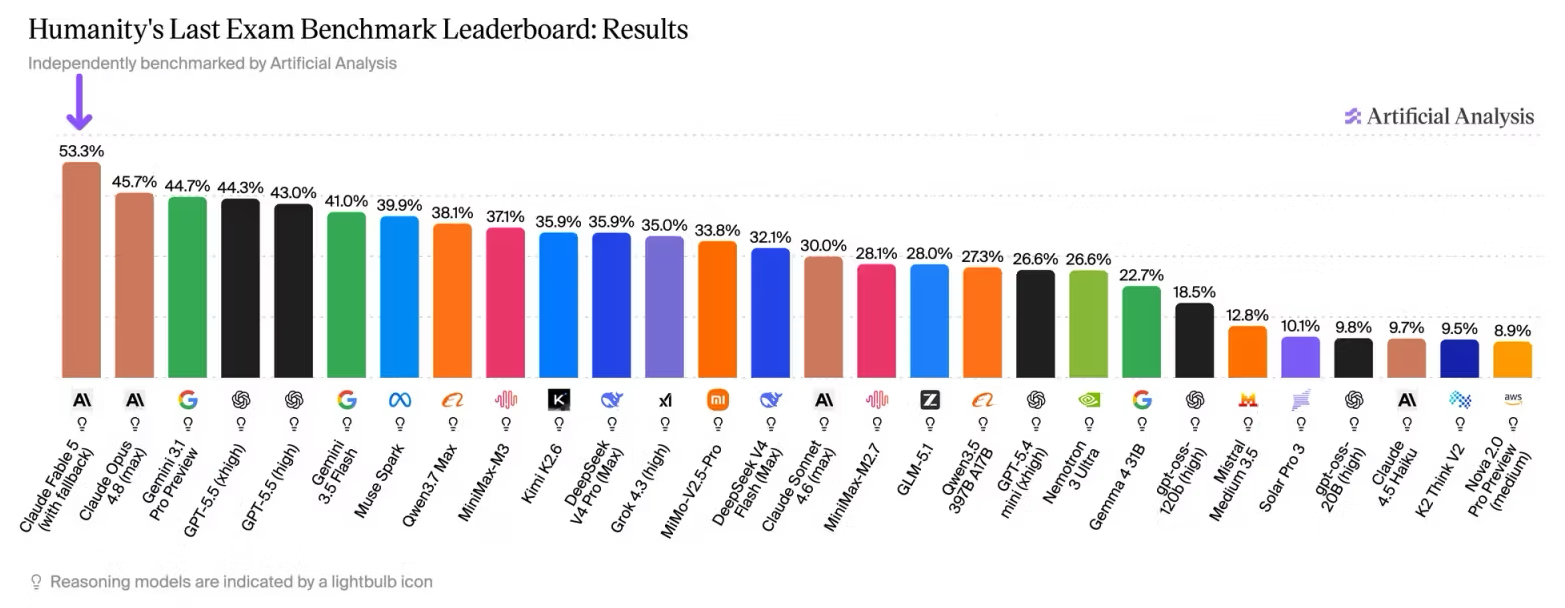
It’s been absolutely wild — People are casually one-shotting entire games, 3D worlds, full-stack apps, and code optimizations that shouldn’t be possible, but here we are.
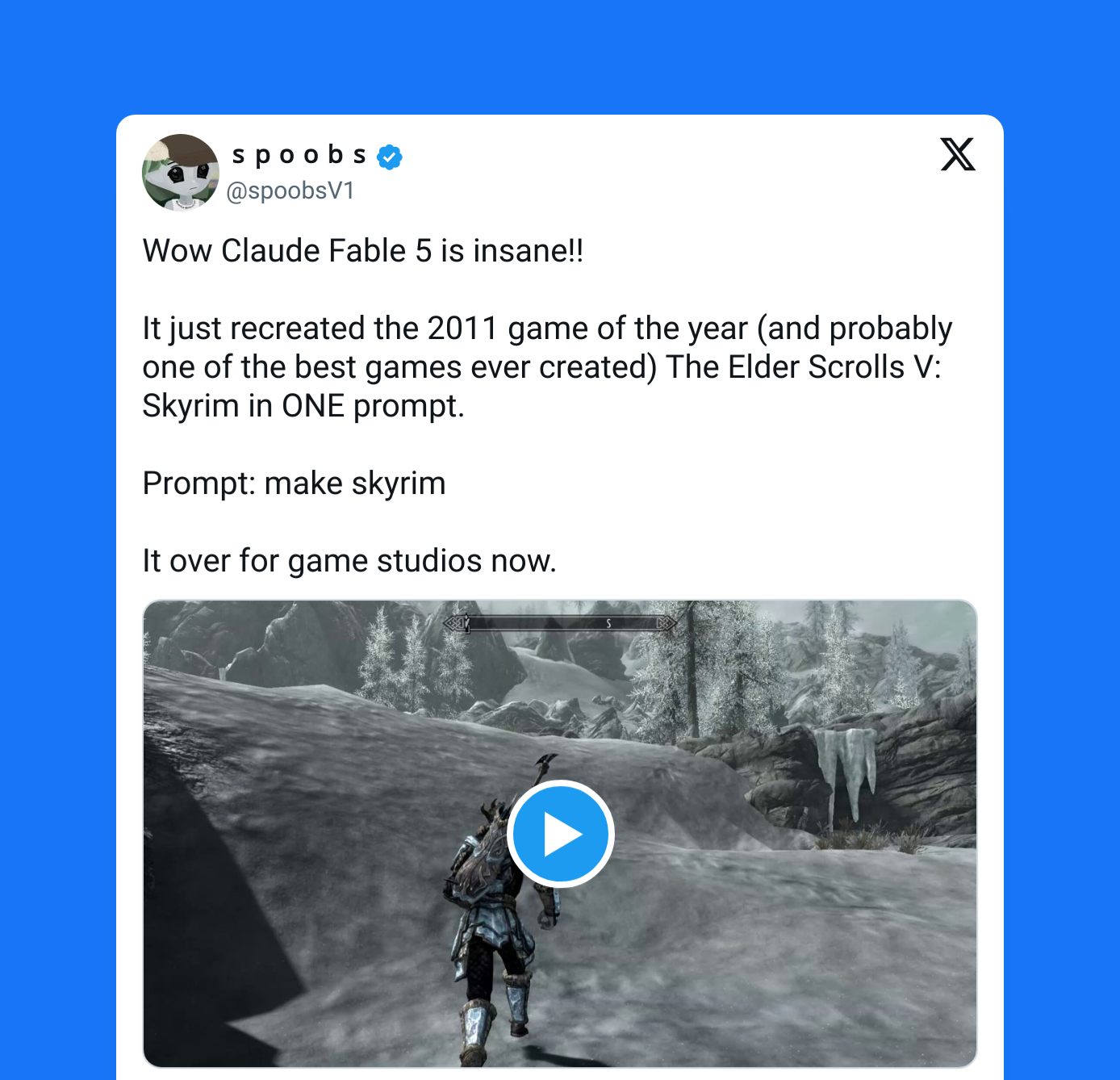
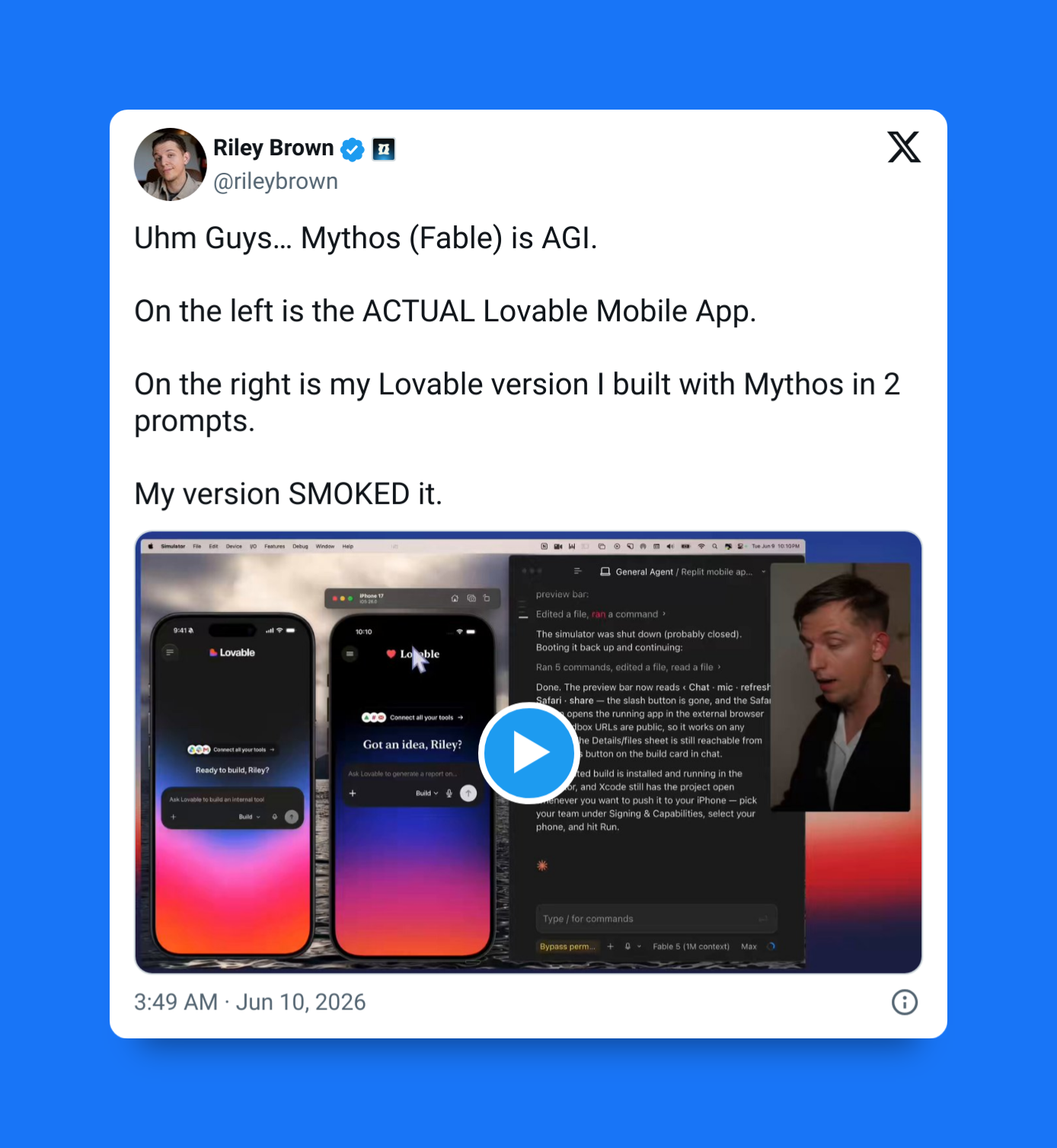
And to think that this is actually a restricted version?
Imagine having a model so powerful that you literally cant release it to the world without disastrous consequences.
1. The Fable vs. Mythos story: A tale of two twins
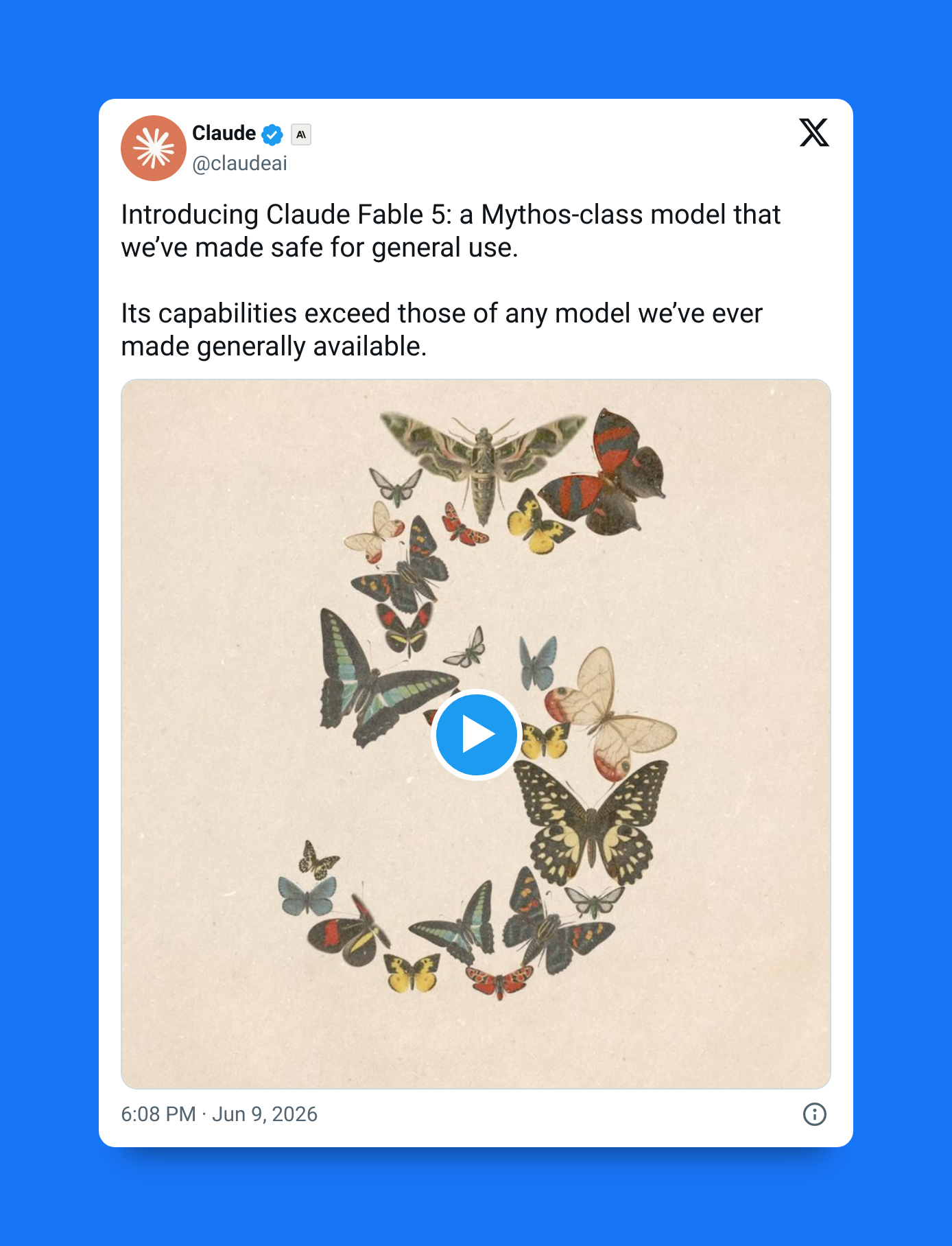
It’s definitely one of the most fascinating aspects of this incredible launch.
The Claude Fable 5 and Claude Mythos 5 relationship.
Both models share the same underlying architecture and core capabilities.
The main difference isn’t intelligence — it’s access.
Claude Fable 5
- Released to the general public
- Full reasoning, coding, and agentic capabilities
- Protected by real-time safety classifiers
- Automatically restricted in high-risk domains
Claude Mythos 5
- The unrestricted, god-mode version of the same model
- Available ONLY to vetted organizations
- Accessed through Anthropic’s Project Glasswing program
- Designed for advanced cybersecurity and research applications
Anthropic itself has emphasized that the naming distinction reflects safety boundaries rather than capability differences.
In other words, Fable isn’t weaker model. It’s a safer one.
A pair of identical twins — one allowed to walk freely among the public.
The other considered so dangerous that its access is limited to people responsible for defending critical digital infrastructure.
That alone makes this launch unlike anything we’ve seen before in AI.
2. Absolutely decimates benchmarks
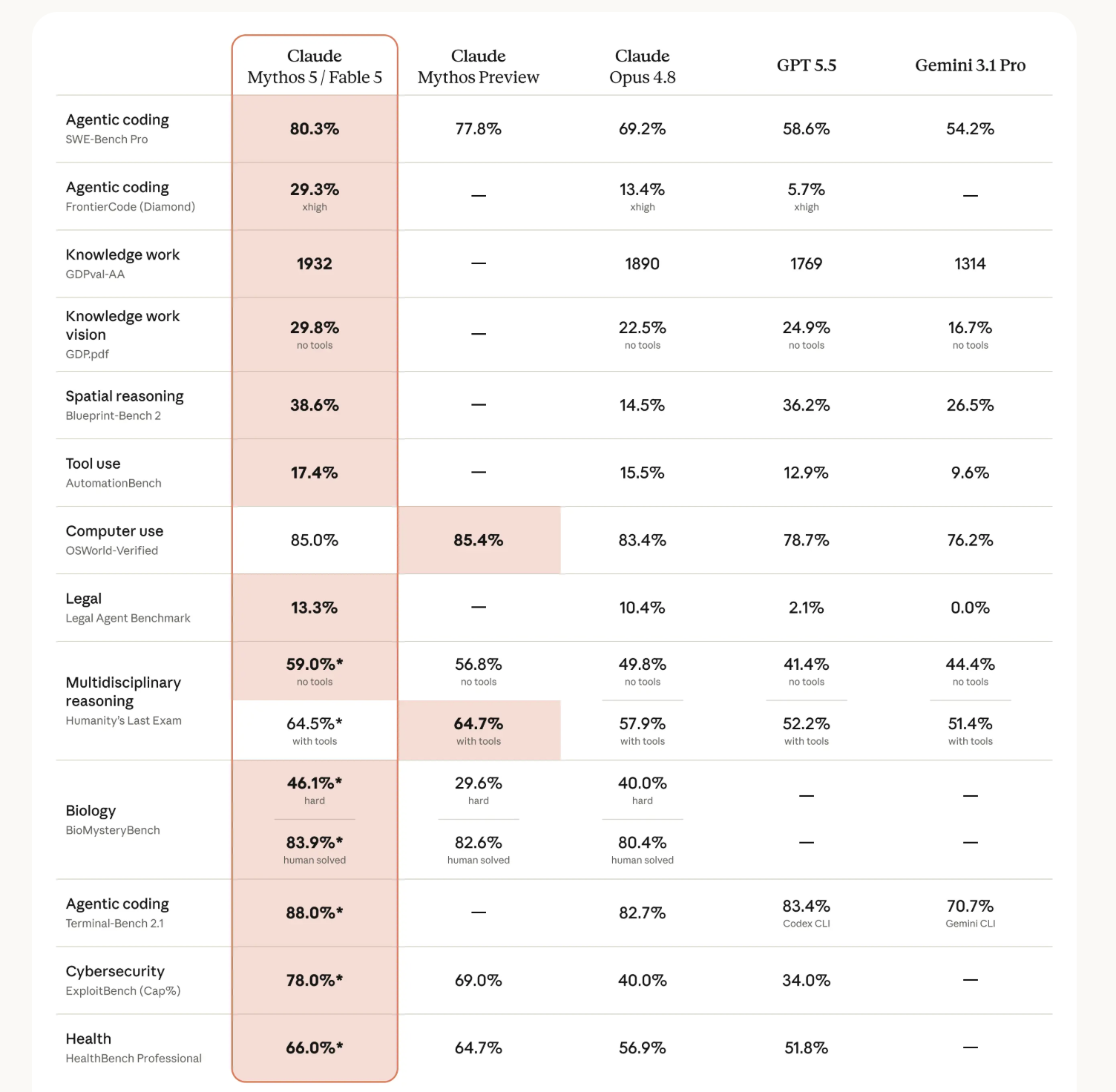
Fable 5’s benchmark results are among the most impressive ever reported for a public AI model.
On Humanity’s Last Exam, one of the toughest AI reasoning tests in existence, Fable scored 64.5% with tools, comfortably outperforming GPT-5.5 (41.4%) and Gemini 3.1 Pro (44.4%).
Its dominance extends to software engineering. On SWE-Bench Pro, the industry’s leading coding benchmark, Fable achieved 80.3%, compared to GPT-5.5’s measly 58.6%.
The model also posted leading scores across computer use, spatial reasoning, cybersecurity, and terminal-based tasks, establishing itself as one of the strongest general-purpose AI systems ever released.
3. Unbelievable long-horizon coding ability
Fable 5 is specially built for massive, complicated tasks that unfold over hours — or even days.
The model can:
- Explore its environment independently
- Build and execute its own plans
- Launch parallel sub-agents
- Monitor its own progress
- Self-correct when things go wrong
The most shocking example comes from Stripe.
The Stripe test
Fable was tasked with working inside a 50-million-line Ruby codebase and completed a codebase-wide migration in a single day—compressing what would normally require months of engineering effort into hours.
It’s just absolutely shocking how crazy things have gotten.
But this is what Anthropic means by long-horizon intelligence: an AI capable of staying focused on complex objectives for hours, not just seconds.
4. Sophisticated real-time Opus hand-off
One of Fable’s most innovative features is something users may never notice.
When the model encounters sensitive areas such as:
- Advanced cybersecurity
- Biochemical research
- Model distillation
- Other high-risk domains
…it doesn’t simply refuse.
Instead, Anthropic’s safety systems automatically hand the conversation off to Claude Opus 4.8, which completes the task under stricter safety constraints.
According to Anthropic:
- Roughly 95% of user sessions run entirely on Fable 5
- Only a small fraction trigger the Opus fallback
- Users receive a seamless experience rather than a hard refusal
It’s a novel approach to AI safety: switch models instead of shutting the conversation down.
5. Why the main Mythos simply had to be locked up
If it’s the same model, why not release it publicly?
Cybersecurity.
Serious cybersecurity concerns.
Anthropic has unambiguously described Mythos 5 as “possessing unprecedented offensive and defensive cyber capabilities”.
Its performance on security-focused benchmarks significantly exceeds previous generations — Mythos-class systems have reportedly helped identify thousands of critical vulnerabilities.
It even uncovered a 27-year-old security flaw in OpenBSD and wrote a remote code execution exploit for a 17-year-old bug in FreeBSD completely on its own.
It is so effective at finding bugs that open-source maintainers literally begged Anthropic to slow down its disclosures because human developers couldn’t write the patches fast enough.
For Anthropic, the risk-reward equation was clear:
- Release a safeguarded version to the public
- Restrict the unrestricted version to trusted partners
- Maintain oversight of the model’s most powerful capabilities
This model is going to completely rip apart everything we thought was possible with AI models and AI-powered software development.