
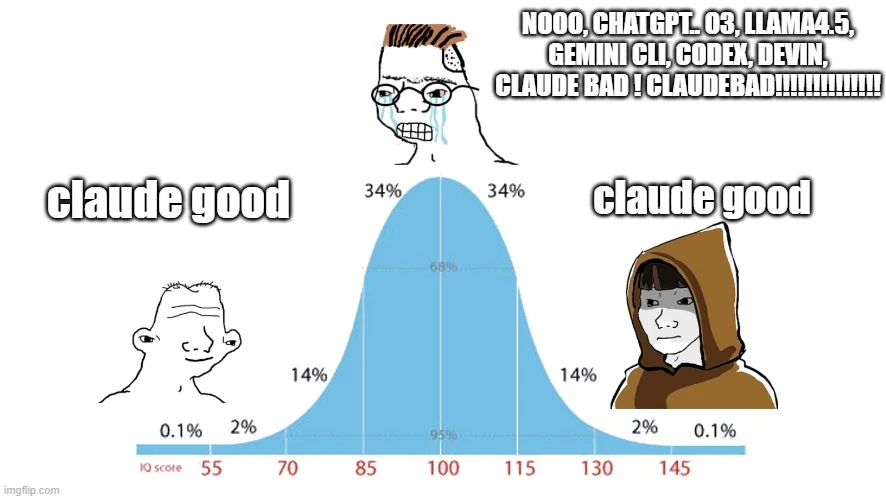
Awesome news:
The new 1 million token context window in Claude Sonnet 4.6 and Opus 4.6 is now generally available to everyone.
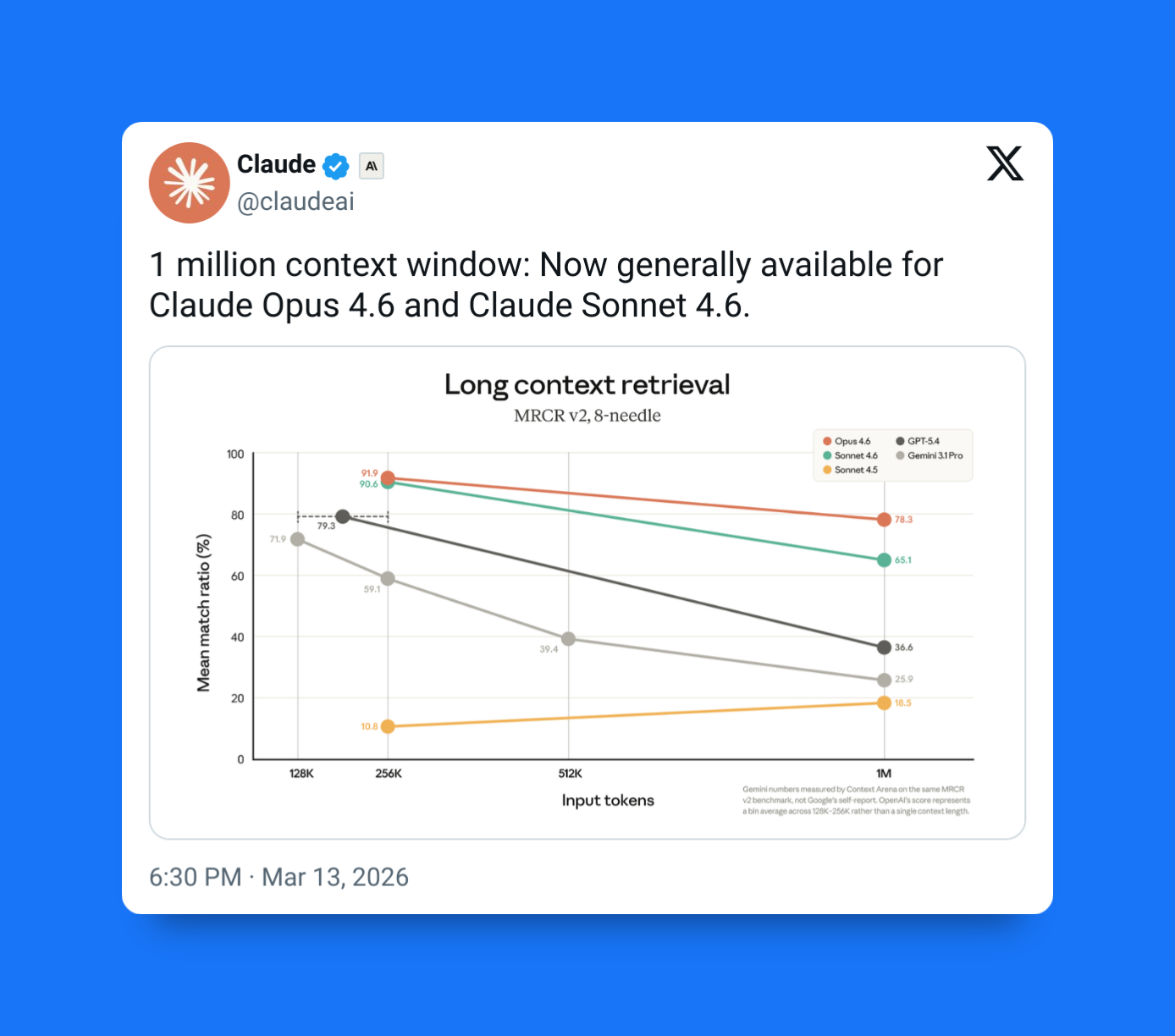
And this number isn’t just a bigger number for Anthropic to brag about — it fundamentally changes how AI can assist us with real software development.
Before:
Coding with AI often meant constantly shrinking problems to fit the model’s memory with context compaction and other hacky techniques.
But now:
Entire codebases, multi-hour long debugging sessions, and intricately connected system context can all stay in view at once.
And not all 1M token context windows are equal you know… other models like GPT and Gemini do have this too — but Claude’s 1M context outshines them — due to its superior long context retrieval — as seen in major benchmarks.
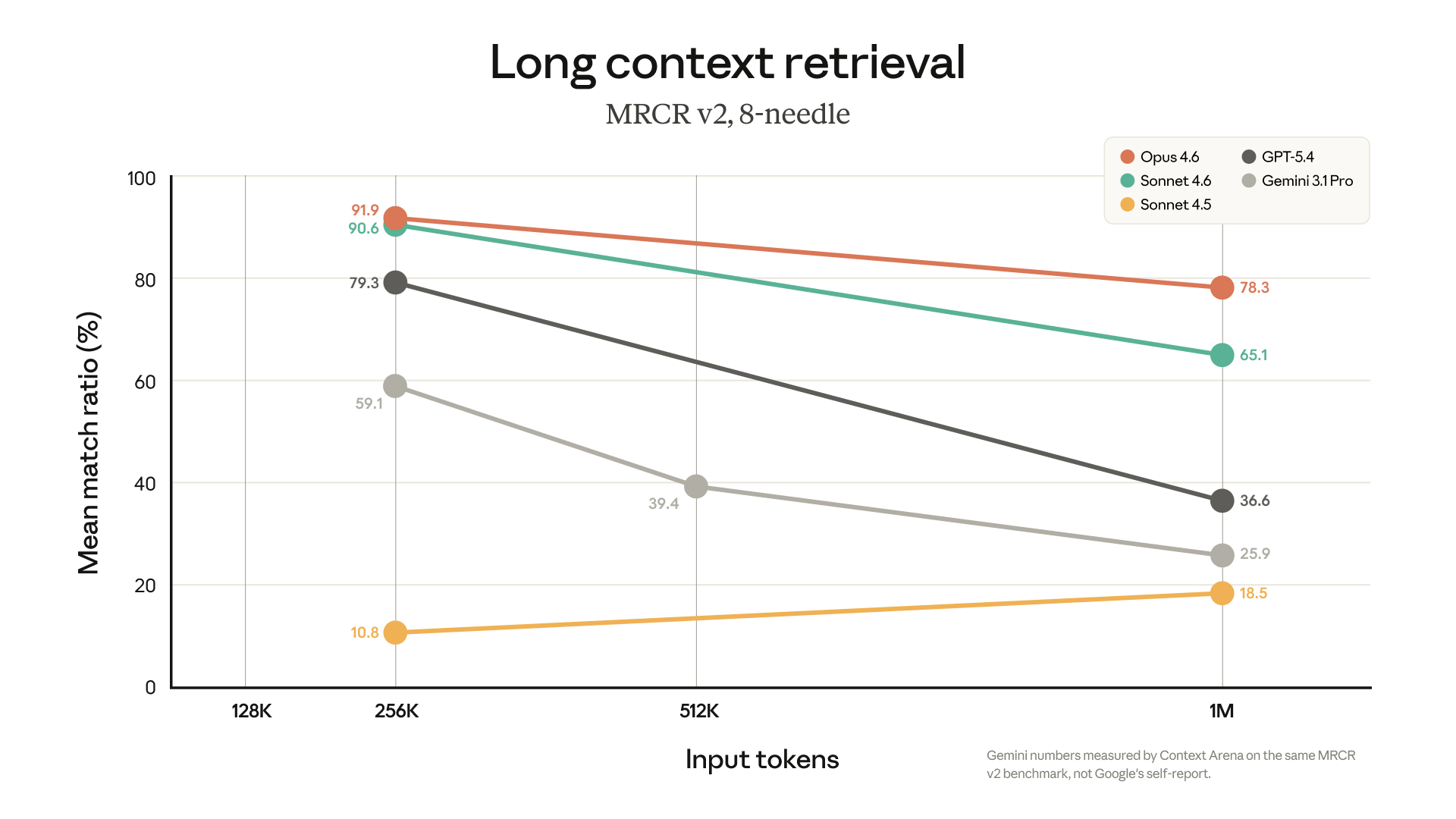
With 1M context now the default, no extra pricing for long inputs, and major improvements in long-context retrieval, developers can finally use AI on the most enormous projects without the any of the usual limitations and accuracy losses.
Let’s look at 5 key ways these changes translate into meaningful upgrades for our everyday coding workflows.
1. Superior whole-codebase understanding leads to smarter fixes and refactors
Context lost — one of the most common frustrations with AI coding tools.
Models often understand a single file well but struggle with how that file fits into the broader system — especially when they can’t fit in all the related files into the context.
With 1M tokens available, Claude can hold far more project information at once, including:
- Multiple services or modules
- API contracts and schemas
- Tests and test expectations
- Documentation and architecture notes
- Logs, stack traces, and debugging context
Instead of constantly reintroducing information, developers can load much more of the codebase into context from the start.
This leads to improvements in tasks like:
- Debugging issues that span multiple files
- Performing architecture-aware refactors
- Maintaining consistency with existing patterns
- Understanding how changes affect dependent modules
Claude becomes much more like a collaborator that understands the full structure of the project — no matter how massive it gets.
2. Pinpointing critical details hidden in massive codebases
Large context windows only help if the model can actually find the right information inside them.
Anthropic measures this with long-context retrieval tests called needle-in-a-haystack benchmarks, which test whether a model can locate a specific fact buried inside extremely large inputs.
Recent results show us just how much this capability has improved:
- Opus 4.6 scored 76% on the 1M-token MRCR benchmark
- Sonnet 4.5 scored around 18% on similar tests
This huge jump shows how Anthropic is improving context navigation, not just context size.
Why this matters for developers:
- A model can find the single relevant interface or function hidden in a huge repo
- It can trace dependency chains across many files
- It can identify the exact assumption that caused a test failure
Without strong retrieval, large contexts become noise. With it, they become a powerful reasoning workspace.
3. Maintaining context across long debugging and development sessions
Real coding work rarely happens in a single prompt. Instead, it unfolds through long investigative sessions:
- Inspect code
- Read logs
- Test hypotheses
- Make changes
- Verify results
- Iterate
Smaller context windows force models to forget earlier discoveries during long sessions.
With 1M tokens, much more of the session history can remain active.
This significantly reduces reliance on context compaction, which summarizes older conversation history when context limits are reached.
The result:
- Fewer lost insights during debugging
- Less repetition explaining earlier findings
- More coherent multi-step reasoning
For long debugging sessions or large migrations, this continuity becomes extremely valuable.
4. Faster iteration by reusing full project context efficiently
Large context windows pair naturally with prompt caching, which allows repeated prompts to reuse previously processed tokens.
This is particularly powerful for coding workflows where a large base context stays mostly the same, such as:
- A full repository snapshot
- API schemas and documentation
- Coding guidelines
- Build instructions and tooling notes
Instead of reprocessing that entire block every time, caching allows follow-up prompts to reuse the existing context.
Benefits include:
- Faster responses for repeated queries
- Lower token costs across long sessions
- More efficient agent workflows
Combined with a 1M window, caching makes “load the codebase once and iterate” a practical development workflow.
5. Making large-scale AI coding practical for everyday development
Perhaps the most developer-friendly change is pricing.
Previously, large context windows often came with extra costs or special tiers. Anthropic removed that friction.
Key changes:
- No extra charge for long context
- 1M tokens available by default
- Standard pricing applies across the full window
For Sonnet 4.6:
- $3 per million input tokens
- $15 per million output tokens
This means a 900K-token prompt costs the same per token as a 9K prompt.
Combined with prompt caching, this dramatically lowers the cost of long-context coding workflows.
Developers can now:
- Load much larger codebases
- Keep more session history intact
- Run deeper investigations
—without worrying that large context usage will suddenly spike costs.
The real upgrade
Claude Sonnet’s 1M token context is not just a bigger memory limit.
It’s a combination of improvements that work together:
- 1M context now available by default
- No premium pricing for long context
- Major improvements in long-context retrieval
- Better synergy with prompt caching
- Reduced reliance on context compaction
Together, these changes allow Claude to work with entire systems instead of isolated snippets.
And for developers, that means fewer broken assumptions, better debugging, and more reliable help on the kinds of complex problems that actually dominate real-world coding.