
And don’t let the “4.6” fool you — this was far from just another incremental upgrade.
Packed with so many brand new features — to keep transforming Claude into a more reliable partner for the most complex tasks.
From 200K context window in Claude Opus 4.5 → 1 million in Opus 4.6.
Much longer output lengths…
A breakthrough collaborative mode between several agents…
New Adaptive Thinking…
It’s not just about focusing on smarter answers or better benchmarks this time — Opus 4.6 is designed around long, multi-step tasks — that usually require planning, context, and consistency across a lot of information.
Large coding projects, research-heavy reports, and business workflows where details matter and mistakes compound quickly.
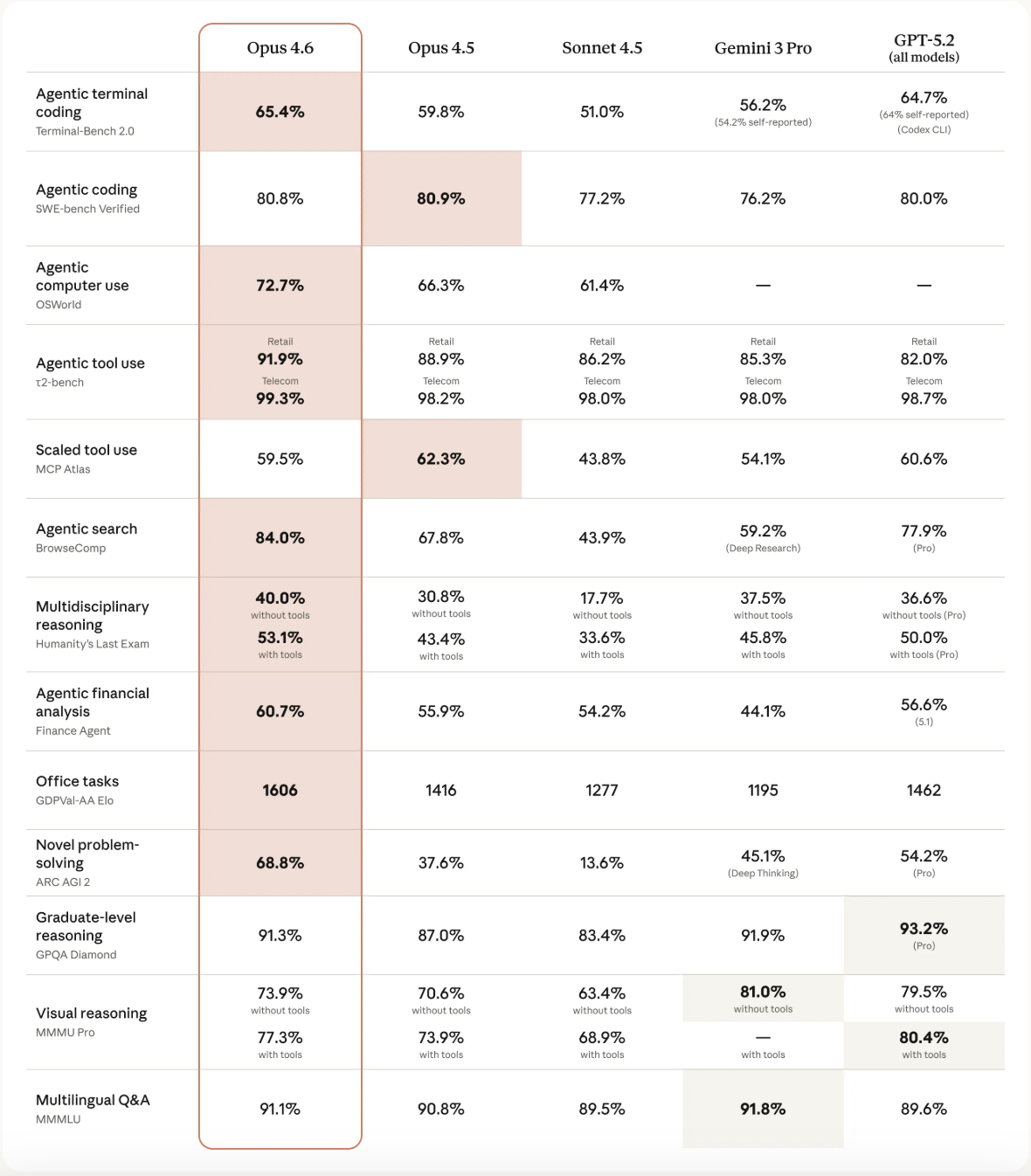
Opus 4.6 takes the lead in all frontier models on Humanity’s Last Exam, attained the highest score on Terminal-Bench 2.0 for agentic coding, and outperformed OpenAI’s GPT-5.2 by 144 Elo points on GDPval-AA (real-world knowledge work tasks).
Bigger is better…
The new massive 1 million token context window lets Claude Opus 4.6 read and keep track of enormous amounts of information at once.
Entire codebases, long document collections, or messy project notes can stay in scope without the model forgetting earlier details.
This makes it much less likely to lose track of critical context during conversation and thinking that compromise its accuracy.
Longer outputs for real work
Anthropic also doubled the maximum output length to 128K tokens.
Claude Opus 4.6 now has more room to produce full drafts, long analyses, or large blocks of code without constantly stopping midway.
And this removes a major annoyance for developers and teams — breaking tasks into smaller chunks just to fit output limits. It’s another signal that Anthropic wants Opus to handle full workflows rather than isolated prompts.
Smarter effort, less micromanaging
❌ Reasoning budget
✅ Reasoning effort
Claude has started following the Gemini approach now, with Opus 4.6.
Earlier versions allowed developers to set strict reasoning budgets — but Opus 4.6 instead uses a more adaptive approach — you guide how much effort the model should spend and let it decide how to allocate that internally.
Making interactions feel less like tuning a machine and more like assigning a task to a capable assistant: explain the goal, set expectations, and let it figure out how much thinking is required.
New Agent Teams
Definitely one of the most notable additions.
With this we can let multiple different agents work simultaneously on different parts of a task while coordinating toward a shared goal.
Instead of a single model handling everything sequentially, work can be divided across specialized agents — for example, planning, implementation, and review — mirroring how human engineering teams operate and improving efficiency on complex projects.
Same positioning — higher expectations
Interestingly, Anthropic hasn’t dramatically changed pricing or positioning. Opus remains the premium, high-capability model in the Claude lineup, aimed at users who need reliability more than speed or cost efficiency.
That also raises expectations. As models get better at handling longer tasks, users expect fewer errors, fewer retries, and outputs that are closer to finished work on the first attempt.
The bigger story behind Opus 4.6 is where AI development is heading. The race is no longer just about intelligence in short bursts. It’s about endurance — how well a model can stay coherent, organized, and useful over extended work sessions.
The challenge now isn’t whether models can generate content, but whether they can reliably carry projects across the finish line.
And that’s a much harder problem — but also a much more valuable one to solve.