
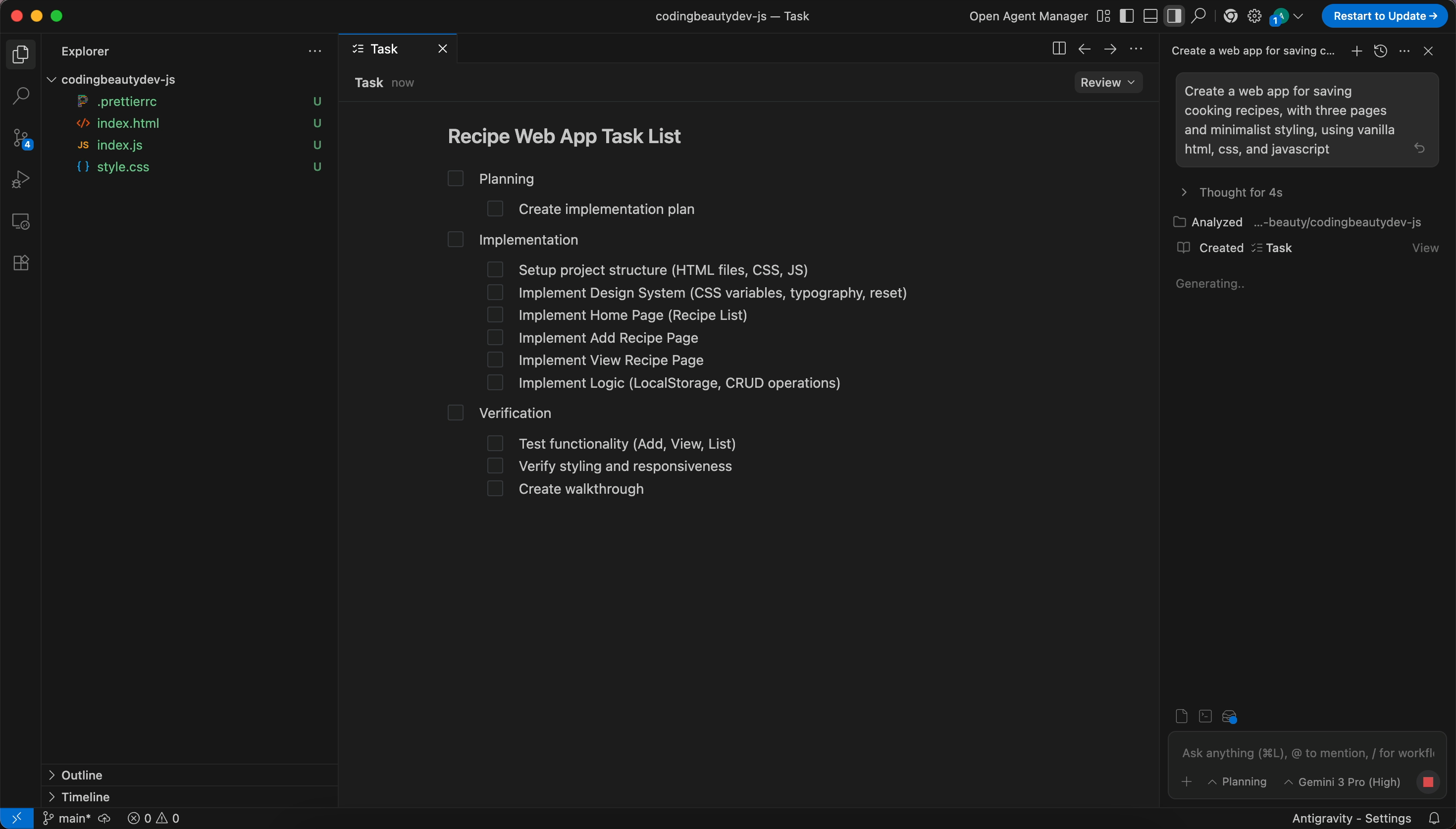
This is going to have such a massive positive impact on the accuracy and reliability of AI agents in software development.
The new Skills feature in the Google Antigravity IDE finally solves the problem of AI agents giving us wildly unpredictable/inaccurate results for the same prompt.
Too little context is terrible for agent accuracy — but things can get even worse when your agent has access to TOO MUCH context for a particular task.
The truth is your coding agent has access to a boatload of input/context that will not be necessary for any given task — but still take part in the agent’s thinking process.
Every single file and folder from every segment segment of your codebase… all the frontend, all the backend, all the tests, scripts, utilities, style guides…
Even all the MCP servers you have connected will also be part of the context…
So what do you think is gonna happen when you give instructions like, “Fix the password reset bug in the API”?
Your agent is going to take every single context it has into consideration for how best to respond to you.
You were only expecting it to change 2 files in the backend, but it went ahead to change 27 files all over the place (“Oh this vibe coding thing is such a scam, i knew it”)
Because you gave it the full responsibility of figuring out what exactly what you thinking. Figuring out the precise locations you wanted changes to be made in. Essential, reading your mind — when all it gave it was a painfully vague instruction.
And while it can do that a decent amount of the time, other times it fails miserably. “Miserably” as far what you were expecting is concerned.
And this is exactly what this new Skills feature from Google is trying to solve.
Skills let you finally give structure to the agent — you can now specify a high-level series of tasks the agent should perform in response to certain kinds of prompts.
Instead of using all the context and input all the time, the agent processes only the context relevant to the task at hand.
It can still intelligently decide how to make changes to your codebase — but only withing the framework and constraints you’ve provided with Skills.
And this is the major breakthrough.
What a Skill actually is
A Skill is just a small folder that defines how a certain kind of task should be done.
At the center of that folder is a file called SKILL.md. Around it, you can optionally include:
- scripts the agent can run,
- templates it should follow,
- reference docs it can consult,
- static assets it might need.
You can scope Skills:
- per project (rules for this repo only),
- or globally (rules that follow you everywhere).
That means you can encode “how we do things here” once, instead of re-explaining it every time.
The key idea: Skills load only when needed
This is the part that actually makes things more reliable.
Antigravity doesn’t shove every Skill into the model’s context up front. Instead, it keeps a lightweight index of what Skills exist, and only loads the full instructions when your request matches.
So if you ask to:
- commit code → commit rules load
- fix a bug → bug-fix workflow loads
- change a schema → safety rules load
Everything else stays out of the way.
Less noise. Less confusion. Fewer “creative interpretations” where you didn’t want any.
What goes inside SKILL.md
A Skill has two layers:
1) The trigger
At the top is a short description that says when this Skill should be used.
This is what Antigravity matches against your request.
2) The playbook
The rest is pure instruction:
- step-by-step workflows
- constraints (“don’t touch unrelated files”)
- formats (“output a PR summary like this”)
- safety rules
When the Skill activates, this playbook is injected into context and followed explicitly.
Another powerful example: commit messages that stop being garbage
Imagine a Skill whose entire job is to handle commits.
Instead of:
“Commit these changes (and please follow our style)”
You encode:
- allowed commit types
- subject length limits
- required “why” explanations
- forbidden vague messages
Now whenever you say:
“Commit this”
The agent doesn’t improvise.
It follows the rules.
Same input.
Same standards.
Every time.
That’s reliability.
3 important ways
Skills improve reliability in three important ways.
1. They turn tribal knowledge into enforcement
Instead of hoping the agent remembers how your team works, you encode it.
2. They can delegate to real scripts
For things that shouldn’t rely on judgment — tests, validation, formatting — a Skill can call actual scripts and report results. That’s deterministic behavior, not vibes.
3. They narrow the decision space
A tightly scoped Skill reduces guesswork. The agent is less likely to invent a workflow when you’ve already defined one.